
For many people, filing for divorce is unfamiliar territory. Questions about custody, property, finances, and court procedures can quickly become overwhelming — especially when trying to navigate the Hawaiʻi Family Court system on the Big Island.
If you are considering divorce in Hilo or elsewhere on the Big Island, understanding how the process generally works can help reduce uncertainty and allow you to make more informed decisions.
At Doi/Luke, Islandlawyers, we assist clients throughout Hilo, Puna, Keaʻau, Mountain View, and surrounding Big Island communities with divorce and family law matters.
Filing for Divorce in Hilo, Hawaiʻi
Divorce cases involving Hilo and East Hawaiʻi are handled through the Hawaiʻi Family Court in Hilo system serving the Big Island. A case typically begins when one spouse files a Complaint for Divorce with the court. The filing spouse is called the “Plaintiff” and the other spouse the “Defendant.”
Hawaiʻi is a no-fault divorce state, which means neither spouse needs to prove wrongdoing to obtain a divorce. In most cases, the court simply needs to find that the marriage is irretrievably broken.
Residency Requirements for Hawaiʻi Divorce
To file for divorce in Hawaiʻi, at least one spouse must reside in the State at the time of filing and have been domiciled or physically present in the state for at least six months before filing. For residents of Hilo and the Big Island, the case is typically handled locally through the Family Court serving Hawaiʻi Island.
After filing, the other spouse must generally be formally served with the divorce documents — unless both parties cooperate through an uncontested process or appearance and waiver procedure. Proper service matters because it gives the court jurisdiction to proceed.
Temporary Orders During Divorce
In many cases, urgent issues arise long before a divorce is finalized. Either party can request temporary orders addressing things like child custody and visitation, child support, spousal support, who stays in the family home, and payment of shared bills and debts. In situations involving safety concerns, the court may also issue temporary restraining orders.
These early hearings can set the tone for the entire case, particularly when children or financial instability are involved, so it’s often worth getting legal guidance before that stage rather than after.
Child Custody Issues in Big Island Divorce Cases
For parents, custody and visitation are often the most emotionally difficult parts of a divorce. Hawaiʻi courts focus on the best interests of the child, considering factors like each parent’s involvement and ability to meet the child’s needs, the stability of each household, school and community ties, and communication between the parents.
Big Island cases can involve logistical challenges that courts elsewhere don’t often encounter. If one parent lives in Hilo and the other parent lives in Laupāhoehoe or even to the west side of the Big Island for example, the parenting schedule, transportation costs, and the child’s school situation all become part of the court’s analysis.
Property Division in Hawaiʻi Divorce
Dividing property in a Hawaiʻi divorce is rarely as simple as splitting things down the middle. The court may need to address real estate, retirement accounts, bank accounts, vehicles, businesses, debts, and separate property claims — and the distinction between marital and separate property isn’t always obvious.
On the Big Island, these issues can take on additional complexity. Family land, agricultural property, multi-generational living arrangements, owner-built homes, and cash-based or self-employment income all present valuation and classification challenges that require careful handling. Property issues specific to East Hawaiʻi might also include trying to value/appraise lava zone properties in Puna, Volcano, or Ka’u, or unpermitted structures such as house additions, ohana units, catchment systems, and agricultural buildings. These factors need to be considered when weighing a division of property in a divorce. Hawaiʻi courts use equitable principles rather than a strict 50/50 formula, which means outcomes can vary significantly depending on the circumstances.
Divorce Mediation & Settlement
Many divorces settle without going to trial, and Hawaiʻi Family Courts often encourage mediation where appropriate. A negotiated resolution can reduce stress, legal costs, and conflict — particularly important for parents who will need to co-parent long after the divorce is final.
That said, mediation isn’t the right path for every case. Where there are significant disagreements over custody, complex assets, or concerns about a spouse’s financial disclosure, litigation may be necessary to protect your interests.
Court Hearings & Trial
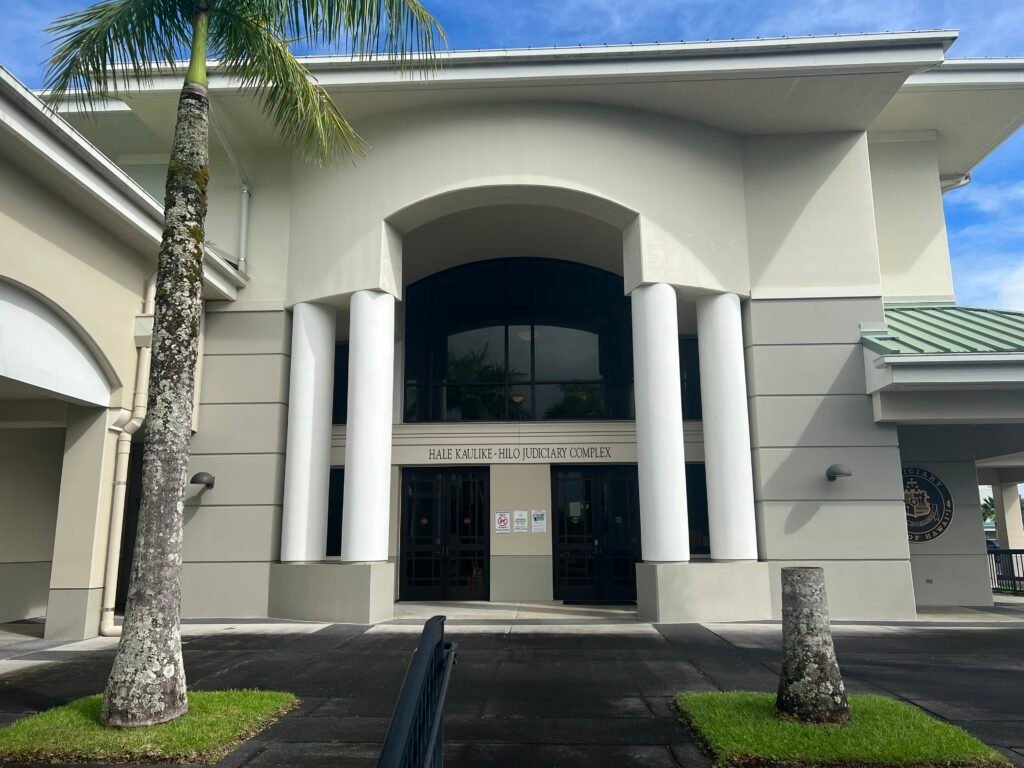
If key disputes remain unresolved, the case may proceed through status conferences, settlement conferences, evidentiary hearings, and ultimately trial. At trial, both parties can present testimony, financial records, witness testimony, expert opinions, and other evidence, after which the judge issues decisions on the unresolved issues. On the east side of the Big Island, hearings are held at Hale Kaulike, the Hilo Courthouse where Family Court is located.
How Long Does Divorce Take in Hilo?
The timeline depends heavily on the complexity of the case. An uncontested divorce with no children and minimal property may move relatively quickly. Contested cases involving custody disputes, business interests, or complex property can take significantly longer — particularly when asset valuation, court scheduling, or mediation timelines are factors.
The single biggest driver of timeline is usually how much the parties can agree on. Cases where both spouses are willing to work toward resolution tend to move faster and cost less than those that proceed to trial.
Court Hearings & Trial
Many clients throughout Hilo, Puna, Keaʻau, Mountain View, and other communities in East Hawai’i prefer legal services that minimize unnecessary travel. Depending on the circumstances, much of a divorce case can be handled through video consultations, telephone meetings, electronic document exchange, and virtual mediation sessions where available — without sacrificing the quality of representation.
Frequently Asked Questions About Divorce in Hilo Family Court
Do I need a lawyer for divorce in Hilo?
Not every divorce legally requires an attorney, but legal representation can be important for protecting your interests on custody, property division, support, and procedural requirements — especially in contested cases.
Can I get divorced in Hawaiʻi if my spouse lives on another island?
Yes. Inter-island divorce cases are common in Hawaiʻi. Custody, visitation, and logistics may become more complicated, but the courts handle these situations regularly.
Does Hawaiʻi divide property 50/50?
Not necessarily. Hawaiʻi courts apply equitable principles when dividing marital property, and outcomes vary depending on the circumstances of each case.
Can grandparents or family members affect a divorce case?
In some situations, yes — particularly where family property, housing arrangements, childcare, or financial support from extended family are involved.
What if my spouse works under the table or hides income?
Income disputes are not uncommon in Hawaiʻi divorce cases, particularly where a party is self-employed or paid in cash. Courts may look at financial records, bank statements, lifestyle evidence, and other documentation when evaluating what a spouse actually earns.
Speak With a Hilo Divorce Lawyer
If you are considering divorce or dealing with a family law matter on the Big Island, Doi/Luke, Islandlawyers assists clients throughout Hilo, Puna, Keaʻau, Mountain View, and surrounding communities. Our firm provides practical guidance tailored to Hawaiʻi families and the unique realities of Big Island family law cases.
To schedule a confidential consultation, call us at (808) 593-2199 or email info@islandlawyers.com.