

A prenuptial agreement—often called a prenup or premarital agreement—allows a couple to decide many of their financial rights and responsibilities before they marry.
For some couples, the goal is protecting property they already own. For others, it may involve a family business, an expected inheritance, real estate, retirement assets, children from an earlier relationship, significant debt, or simply a desire to establish clear financial expectations before marriage.
A good prenuptial agreement is not necessarily about anticipating divorce. It is about planning ahead.
By addressing financial issues while the relationship is strong, a couple can reduce uncertainty, protect important assets and family interests, and make informed decisions about how they want their financial relationship to work.
Hawaiʻi has specifically authorized prenuptial agreements through the Hawaiʻi Uniform Premarital Agreement Act, Hawai’i Revised Statutes (“HRS”) Chapter 572D.
Doi/Luke, Attorneys at Law has assisted clients with Hawaiʻi prenuptial agreements since 1995. Our work includes drafting agreements, reviewing agreements prepared for a prospective spouse, negotiating proposed terms, and litigating the validity and enforcement of prenuptial agreements in divorce cases.
A prenuptial agreement is a written contract entered into by two people in contemplation of marriage.
Under HRS § 572D-2, a Hawaiʻi premarital agreement must be in writing and signed by both parties.
The agreement does not become effective merely because it is signed. Under HRS § 572D-4, it becomes effective when the parties actually marry. If the contemplated marriage never takes place, the prenuptial agreement does not become effective.
Prenuptial agreements are different from postnuptial or postmarital agreements, which are agreements made after the parties are already married. Although both types of agreements can address similar subjects, different legal considerations can apply.
Prenuptial agreements are sometimes associated only with extremely wealthy couples.
In practice, they can be useful in many different circumstances.
A prenup may be worth considering when one or both people:
own a home or other real estate before marriage;
have substantial savings or investments;
own or have an interest in a business or professional practice;
expect to receive an inheritance or significant family gifts;
have interests in family land, trusts, or closely held family assets;
have retirement accounts or pension benefits accumulated before marriage;
have children from a previous relationship;
are entering a second or later marriage;
have significant debts or financial obligations;
expect substantial differences in future earnings;
want to keep income or property acquired during marriage separate;
want to clarify whether either spouse will receive alimony if the marriage ends; or
simply want greater financial predictability before marrying.
A prenup does not have to be completely one-sided.
Some agreements primarily protect one person’s premarital assets. Others create protections for both people. A couple might agree that each keeps certain separate property while jointly sharing other property acquired during the marriage. They might establish increasing financial protections depending on the length of the marriage or agree in advance how jointly acquired assets will be divided.
The agreement can be tailored to the couple rather than using a one-size-fits-all approach.
One of the persistent misconceptions about prenuptial agreements is that one wealthy person uses a prenup to protect assets from a less wealthy fiancé or fiancée.
That certainly can be one scenario.
But it is far from the only one.
Consider a couple where one person owns a condominium, the other has substantial retirement savings, one has student loans, both expect their careers and incomes to grow, and each expects to receive family assets sometime in the future.
Neither may consider themselves “wealthy.”
Yet after a 20- or 30-year marriage, the financial consequences of divorce could be significant.
A prenup allows them to decide before marrying which financial interests they want to keep separate and which they want to share.
For some couples, that clarity can actually make financial conversations easier.
Instead of avoiding difficult subjects, they enter the marriage having discussed their property, debts, expectations, and long-term financial plans.
One of the most common purposes of a prenup is to define what happens to property a person already owns before the marriage.
That may include:
a home or condominium;
investment accounts;
savings;
retirement assets;
rental property;
land;
valuable personal property; or
an interest in a company or professional practice.
An agreement can specify that identified property will remain that person’s separate property if the marriage later ends.
It can also address a more complicated question: what happens to the property during the marriage?
For example, a house owned before marriage may increase substantially in value over 20 years. Mortgage payments may be made during the marriage. The couple may renovate it together. One spouse may contribute money or labor to property owned by the other.
A well-drafted agreement can address those possibilities in advance rather than leaving them for a future divorce court to untangle.
A prenup can do more than protect what a person already owns.
Hawaiʻi law permits prospective spouses to define rights in property acquired in the future, including income and earnings.
For example, a couple might agree that:
each person’s earnings remain separate;
earnings during marriage will be marital or joint property;
separately titled investment accounts remain separate;
certain property acquired with separate funds remains separate;
a jointly purchased home will be divided according to specified percentages; or
property will be treated differently depending upon how it is titled or funded.
These decisions can be customized to reflect the couple’s actual financial goals.
Protecting family property is another common reason for preparing a prenup.
A person may expect to inherit a family home, investment assets, land, an interest in a family business, or trust distributions. In Hawaiʻi, concerns about maintaining family property can be particularly important when real estate or land has remained within a family for generations.
It can also address related issues such as:
appreciation in inherited property;
income produced by inherited assets;
the use of inherited funds during the marriage;
property purchased with inherited funds; and
what happens if inherited property is mixed with jointly owned assets.
Business owners often have particularly strong reasons to consider a prenuptial agreement.
Even when a person owns a business before marrying, significant questions can arise years later concerning growth in the business’s value, income generated from the business, reinvested profits, contributions made during the marriage, or the involvement of the other spouse.
A prenup can address issues such as:
ownership of the business;
appreciation in business value;
management and voting rights;
income and distributions;
business debt;
whether the other spouse will acquire any ownership interest;
valuation methods; and
what happens to the business in the event of divorce.
This can be important not only to the marrying couple, but also to business partners, other shareholders, and family members with interests in the company.
Real estate is frequently one of the largest assets addressed in a prenuptial agreement.
The agreement can address property already owned by either person as well as property purchased after marriage.
Depending upon the couple’s goals, the agreement may specify:
whether property remains separate;
whether the other spouse acquires an interest;
how mortgage payments are treated;
how improvements or renovations are treated;
how appreciation is handled;
how jointly purchased property will be divided; and
what happens if separate funds are used toward a jointly owned property.
Clear provisions are particularly valuable because real estate may appreciate substantially over the course of a long marriage.
Prenuptial planning is not limited to assets.
One person may enter the marriage with student loans, business liabilities, credit-card debt, tax obligations, or other significant financial obligations.
An agreement can identify existing debts and establish how those obligations will be treated between the spouses.
It can also provide rules concerning certain debts incurred after marriage.
Couples can also address how retirement accounts and other retirement-related assets will be treated if the marriage ends.
A prenup might distinguish between retirement benefits accumulated before marriage and benefits accumulated afterward or establish some other agreed method of division.
Retirement assets are subject to special federal rules, however. Under federal law, a spouse’s waiver of survivor benefits in many employer-sponsored plans—such as pensions and 401(k) plans—is generally effective only if it is signed after the marriage. For that reason, a prenup addressing those benefits is commonly followed by a separate spousal consent or waiver signed after the wedding. Dividing a retirement plan in a divorce may also require a qualified domestic relations order (QDRO).
Hawaiʻi law specifically permits a prenuptial agreement to modify or eliminate alimony (also known as spousal support).
Couples therefore have substantial flexibility.
An agreement might:
waive alimony entirely;
limit the amount of alimony;
limit how long alimony may be paid;
provide different rights depending on the duration of the marriage; or
preserve the parties’ ordinary rights to seek alimony under Hawaiʻi divorce law.
There is an important statutory limitation. If enforcing a provision modifying or eliminating support would make one spouse eligible for public assistance at the time of separation or divorce, the court may require support to the extent necessary to avoid that eligibility.
Prenuptial agreements can also work alongside estate planning.
Hawaiʻi law allows premarital agreements to address matters including wills, trusts, life-insurance benefits, and the disposition of property upon death.
This can be particularly important for people entering second marriages or people who want to provide for children from an earlier relationship while also making appropriate provision for a new spouse.
Because estate-planning and probate laws can create additional requirements, the prenup should be coordinated with appropriate wills, trusts, beneficiary designations, and other estate-planning documents where necessary.
Although Hawaiʻi law gives couples considerable flexibility, a prenuptial agreement cannot control everything.
HRS § 572D-3 specifically provides that a child’s right to support cannot be adversely affected by a premarital agreement.
Parents cannot use a prenup to eliminate a future child’s right to appropriate financial support.
Child support is determined under Hawaiʻi law based upon the circumstances that exist when support is actually being decided.
A couple also cannot conclusively determine future child custody or visitation through a prenup.
When custody is later determined, the Family Court must decide what arrangement is in the best interests of the child based upon the circumstances existing at that time.
A provision stating what the parents presently hope will happen may reflect their intentions, but it cannot prevent a Family Court from entering a different custody order when the child’s best interests require it.
Hawaiʻi’s statute permits parties to address a broad range of matters, including certain personal rights and obligations, as long as the provisions do not violate public policy or a criminal statute.
That does not mean every imaginable lifestyle provision belongs in a prenup.
Provisions involving finances and property tend to be far more practical and predictable than attempts to regulate personal behavior during marriage.
The primary purpose of a well-drafted agreement is usually to create clear, enforceable financial rules—not to write a rulebook for married life.
A properly prepared prenuptial agreement can significantly change the financial outcome of a divorce.
For that reason, the process used to prepare the agreement can be just as important as the words in the final document.
Under HRS § 572D-6, a premarital agreement is enforceable and binding unless the person opposing enforcement proves one of the statutory grounds for avoiding it.
There are two such grounds:
1. Involuntariness. The challenging party did not sign the agreement voluntarily.
2. Unconscionability combined with inadequate disclosure. The agreement was unconscionable when it was signed, and, before signing, the challenging party (a) was not given fair and reasonable disclosure of the other party’s property or financial obligations, (b) did not expressly waive, in writing, the right to further disclosure, and (c) did not have, and reasonably could not have had, adequate knowledge of the other party’s property or financial obligations.
Unconscionability is decided by the judge as a matter of law. The Hawaiʻi Supreme Court has described it as involving two principles: one-sidedness and unfair surprise.
A person must enter into a prenuptial agreement voluntarily.
Questions can therefore arise later concerning coercion, duress, surprise, pressure surrounding an approaching wedding, bargaining circumstances, or whether a person understood what was being signed.
In L.R.O. v. N.D.O. (2020), the Hawaiʻi Supreme Court adopted a set of factors for courts to consider when the voluntariness of a premarital agreement is disputed. They include:
coercion resulting from how close to the wedding the agreement was signed;
surprise in how the agreement was presented;
whether the person had independent counsel, or a reasonable opportunity to consult one;
inequality of bargaining power, including the parties’ relative age and sophistication;
whether there was full disclosure of assets; and
each party’s understanding of the rights being waived and awareness of the agreement’s intent.
In that case, the court upheld an agreement signed on the wedding day. That result rested on specific findings, including that the wife had received a copy of the agreement weeks earlier and had been given the opportunity to hire her own attorney. It is not a model to follow.
The lesson for couples preparing an agreement is straightforward:
A prenup should not simply be a document placed in front of someone shortly before the wedding with instructions to sign it.
A better process allows time for review, discussion, negotiation, financial disclosure, and independent legal advice.
Financial disclosure is an important part of preparing a strong prenuptial agreement.
Before agreeing to give up or modify financial rights, each person should have a reasonable understanding of the other’s financial circumstances.
Depending upon the couple, disclosure may include:
real estate;
bank and investment accounts;
retirement accounts;
business interests;
significant personal property;
debts and liabilities;
trusts or existing beneficial interests; and
income information.
The goal is not necessarily to produce a forensic accounting of every dollar a person owns.
The goal is for both prospective spouses to understand the financial situation they are dealing with and to create a record showing that reasonable disclosure took place.
This can become extremely important if someone later claims that the agreement should not be enforced.
Under HRS § 572D-6, a party can waive, in writing, disclosure beyond what was provided. A written waiver, however, is a poor substitute for actual disclosure—and full disclosure of assets is also one of the voluntariness factors identified in L.R.O. v. N.D.O. Attaching disclosure schedules to the agreement itself is a sensible and necessary practice.
Hawaiʻi’s Uniform Premarital Agreement Act does not state that each person must have an attorney for every prenup to be enforceable.
Nevertheless, independent legal representation is strongly recommended.
Ordinarily, the attorney preparing the agreement represents one prospective spouse. The other person should have the opportunity to retain a separate attorney to review the proposed agreement, explain the legal rights affected by it, suggest changes, and advise whether signing is in that person’s interests.
Separate representation has several benefits.
It helps both people understand the agreement. It creates a more balanced negotiation process. And if the agreement is challenged years later, independent legal advice can provide important evidence that the parties entered into the agreement knowingly and voluntarily. Independent counsel—or a genuine opportunity to consult one—is one of the voluntariness factors identified in L.R.O. v. N.D.O.
An attorney preparing a prenup should therefore not be viewed as the attorney for “the couple.” The attorney represents the individual client.
Hawaiʻi law does not require that a prenuptial agreement be signed a particular number of days before the wedding.
There is no automatic 30-day, 14-day, or 7-day rule.
But timing still matters.
For many couples, beginning the process approximately two to three months before the wedding provides reasonable time to:
discuss the desired terms;
exchange financial information;
prepare an initial draft;
allow the other prospective spouse to obtain independent counsel;
negotiate requested changes;
prepare the final agreement; and
sign it without the pressure of an imminent wedding.
More complicated agreements should often begin even earlier.
A couple dealing with several businesses, trusts, substantial real estate, family wealth, or more extensive negotiation may benefit from starting three, four, six, or more months ahead.
Starting early rarely causes a problem.
Starting too late can.
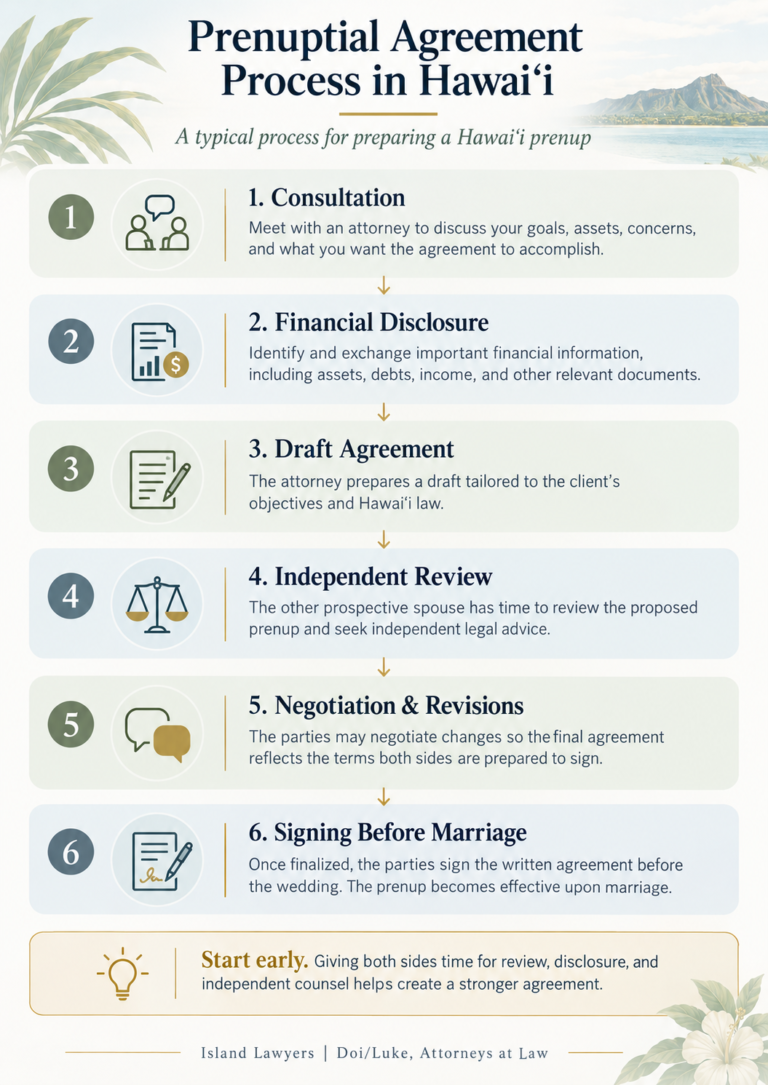
Although every case is different, the process usually involves several steps.
The first step is determining what the client wants the agreement to accomplish.
We discuss the client’s property, finances, family circumstances, concerns, and goals.
For some clients, protecting a single piece of real estate may be the primary objective. For others, the agreement may involve businesses, investments, estate planning, anticipated inheritance, retirement assets, or a comprehensive financial structure for the marriage.
The parties identify their major assets, debts, and financial obligations.
Depending upon the circumstances, supporting financial documents may also be exchanged.
The attorney prepares a draft addressing the client’s objectives while considering the requirements of Hawaiʻi law and the practical issues that may arise if the agreement ever needs to be enforced.
The proposed agreement is provided to the other prospective spouse.
That person should have adequate time to review the agreement and obtain independent legal advice.
Prenups are contracts, and negotiation is normal.
The other party or attorney may suggest revisions. Terms may change as both people discuss how they want their financial relationship structured.
Negotiation does not weaken a prenup.
To the contrary, a documented process in which both parties participate can demonstrate that the final agreement was genuinely considered rather than simply imposed.
Once the terms are finalized, the parties sign the written agreement before marriage.
The agreement then becomes effective when the marriage occurs.
Yes.
A spouse can challenge a prenuptial agreement during divorce litigation.
But the fact that an agreement is challenged does not mean the court will disregard it.
Hawaiʻi law starts from the position that premarital agreements are enforceable unless the person opposing enforcement proves a recognized statutory ground for avoiding the agreement.
Challenges often focus on questions such as:
Was the agreement signed voluntarily?
Was it presented at the last minute?
Did the person understand what the agreement did?
Did the parties negotiate?
Was there adequate financial disclosure?
Did the person have an opportunity to consult an attorney?
Were there threats or coercion?
Was the agreement unconscionable when signed, and was financial disclosure inadequate?
A contested prenup can become a significant case within the larger divorce.
Documents created years earlier—drafts, disclosure schedules, emails, correspondence between attorneys, and records concerning the negotiation—may become important evidence.
This is why good drafting is only part of preparing a prenup.
A good process creates a good record.
Yes.
Under HRS § 572D-5, after the parties marry, a premarital agreement may be amended or revoked by a written agreement signed by both parties.
Couples sometimes revisit an agreement when their circumstances change significantly.
For example, the parties may later decide that an original provision no longer reflects how they want to handle property, a business, or financial support.
Because an agreement made after marriage raises somewhat different legal considerations from an agreement entered into beforehand, parties considering an amendment should obtain appropriate legal advice.
Not necessarily—but wealth is not the only reason to have one.
A prenup may be useful when either person owns real estate, has retirement savings, owns a business, expects an inheritance, has children from another relationship, carries substantial debt, or simply wants greater certainty about financial rights if the marriage ends.
No. Hawaiʻi law does not establish a specific number of days.
Nevertheless, beginning and completing the process well before the wedding is preferable because it allows adequate time for disclosure, legal advice, negotiation, and voluntary decision-making.
Yes. A prenuptial agreement can address the treatment of future inheritances and gifts even though the precise property or amount may not yet be known.
Yes. Hawaiʻi law permits premarital agreements to modify or eliminate spousal support, subject to the statutory limitation concerning eligibility for public assistance.
The attorney drafting or negotiating the prenup ordinarily represents one party, not both prospective spouses.
The other person should be encouraged to retain independent counsel to review the agreement and advise that person separately.
Hawaiʻi’s statute requires only that a premarital agreement be in writing and signed by both parties; notarization is not a statutory requirement. Even so, agreements are commonly signed before a notary, which helps confirm who signed and when.
Yes. Much of the process can often be handled remotely through video consultations, electronic exchange of documents, and communication between the parties and their attorneys.
Doi/Luke represents prenup clients throughout Hawaiʻi, including clients on all the Neighbor Islands, in other states, and even other countries.
A prenuptial agreement may ultimately be judged many years after it was prepared.
That makes experience particularly valuable.
Since 1995, attorney Gavin Doi has handled hundreds of prenuptial agreements in Hawaiʻi, including drafting agreements, reviewing agreements prepared by other attorneys, negotiating proposed terms, and litigating disputes concerning their validity and enforceability in divorce proceedings.
That litigation experience informs our approach to drafting.
We consider not only what the agreement says today, but also how the agreement—and the process used to prepare it—may look to a Family Court judge years in the future.
Gavin has also been invited to speak about prenuptial agreements to the Hawaiʻi State Bar Association Family Law Section, the Maui Family Bar, and the Financial Planning Association of Hawaiʻi.
Doi/Luke, Attorneys at Law assists clients with prenuptial agreements throughout Hawaiʻi from our Honolulu office and our Hawaiʻi Island presence. Remote consultations are also available.
If you are considering a prenuptial agreement, beginning the process early is usually the best approach.
Call (808) 593-2199 or contact us through our website to schedule a consultation.
This page is provided for general informational purposes only and should not be construed as legal advice. The appropriate terms and preparation of a prenuptial agreement depend upon the particular circumstances of the people involved. If you need legal advice concerning a premarital agreement, consult a qualified attorney..