

You are getting married. The venue is booked, invitations have gone out, and the wedding is approaching.
“Is it too late?”
There is no Hawaiʻi law requiring a prenuptial agreement to be signed a specific number of days or weeks before the wedding. But that does not mean timing is unimportant.
As a practical matter, couples should generally begin discussing and preparing a prenuptial agreement well before the wedding—ideally several months in advance. Starting early gives both people enough time to exchange financial information, consult with attorneys, negotiate the terms, and consider the agreement without the pressure of an approaching wedding date.
For many couples, beginning the process two to three months before the wedding provides a reasonable amount of time. Couples with businesses, trusts, substantial assets, complicated real estate holdings, or more extensive negotiations may want to begin even earlier.
The important point is not simply to beat a particular deadline.
It is to create a process in which both people have enough time to understand what they are signing and make a voluntary, informed decision.
Key takeaways:
- Hawaiʻi has no deadline requiring a prenup to be signed a set number of days before the wedding, but timing still matters for enforceability.
- Courts look at voluntariness, including how close to the wedding the agreement was signed. See HRS § 572D-6; L.R.O. v. N.D.O. (Haw. 2020).
- A good target for most couples: start the process two to three months out. Complex finances (businesses, trusts, significant assets) may call for more time in advance.
Does Hawaiʻi Have a Deadline for Signing a Prenup?
No.
Hawaiʻi’s Uniform Premarital Agreement Act requires a prenuptial agreement to be in writing and signed by both parties. The statute does not say that it must be signed 30 days, 14 days, 7 days, or any other particular amount of time before the marriage. See HRS § 572D-2.
A premarital agreement becomes effective when the parties marry.
But another part of the Hawaiʻi statutes explains why the timing of the agreement can nevertheless become important.
Under HRS § 572D-6, a prenuptial agreement may be challenged if the person opposing enforcement proves, among other possible grounds, that the agreement was not executed voluntarily.
That is where waiting until the last minute can create problems.
Why Does the Timing of a Prenup Matter?
Imagine receiving a proposed prenuptial agreement three days before a 150-person wedding.
Guests are already flying to Hawaiʻi.
The hotel has been paid.
The caterer has been paid.
Family members have arrived.
And one of the marrying parties says:
“Sign this agreement or the wedding is off.”
Even if the agreement itself contains reasonable terms, that is not an ideal factual situation if its enforceability is later challenged in a divorce.
The closer a prenup is presented and signed to the wedding, the easier it may be for someone later to argue that there was inadequate time to:
- understand the agreement;
- obtain independent legal advice;
- review financial information;
- negotiate changes;
- consider the consequences of signing; or
- realistically decide not to sign.
None of those circumstances automatically makes a Hawaiʻi prenup unenforceable.
But they can become relevant to the question of voluntariness.
What Has the Hawaiʻi Supreme Court Said About Last-Minute Prenups?
The Hawaiʻi Supreme Court addressed this issue directly in L.R.O. v. N.D.O., 148 Hawaiʻi 336, 475 P.3d 1167 (2020).
In that case, the parties actually signed their prenuptial agreement on the same day they married. Nevertheless, the Court upheld the agreement.
That does not mean signing a prenup on your wedding day is a good idea.
The circumstances surrounding the agreement were important.
The family court found, among other things, that the wife had received the agreement weeks earlier, understood its purpose, raised concerns about one of its provisions, and obtained a modification favorable to her. The evidence also supported a finding that she had an opportunity to consult independent counsel.
Most importantly for future Hawaiʻi cases, the Hawaiʻi Supreme Court adopted several factors for courts to consider when determining whether a prenuptial agreement was entered into voluntarily.
Those considerations include:
- possible coercion caused by how close the signing was to the wedding;
- whether the agreement was presented as a surprise;
- whether each party had independent counsel or an opportunity to consult independent counsel;
- differences in bargaining power;
- whether there was full financial disclosure; and
- whether the parties understood the rights being waived or at least understood the purpose of the agreement.
In other words, there is no automatic “too late” rule—but the circumstances matter.
So When Should You Start the Prenup Process?
As a practical guideline, we generally prefer to see couples begin the process at least two to three months before the wedding.
That does not mean every prenup requires three months.
Some agreements are relatively straightforward, while others are not.
Consider the difference between these two couples.
Couple One: Relatively Simple Finances
Each person has:
- a retirement account;
- some savings;
- one piece of real estate; and
- ordinary employment income.
They generally agree that premarital property should remain separate and that property accumulated together during the marriage should be shared.
Their agreement may be relatively straightforward.
Couple Two: More Complicated Finances
One person owns:
- several rental properties;
- a closely held business;
- an interest in a family partnership;
- substantial investments; and
- an expected interest in a family trust.
The other person wants to understand how income, appreciation of assets, retirement benefits, inheritance, and alimony will be treated.
That prenup may require considerably more discussion, financial disclosure, document review, and negotiation.
Starting three, four, or even six months before the wedding may make much more sense.
What Actually Takes Time When Preparing a Prenup?
1. Deciding What the Agreement Should Accomplish
The couple first needs to think about what they actually want the prenup to cover.
Questions might include:
- Will premarital property remain separate?
- What happens to income earned during the marriage?
- How will property purchased together be treated?
- What happens to appreciation of separate property?
- How will businesses be treated?
- What happens to inheritances and gifts?
- Will the agreement address alimony?
- How will retirement assets be handled?
Those discussions can take time.
2. Financial Disclosure
Each person should have a reasonable understanding of the other’s financial circumstances before signing the agreement.
That may involve identifying:
- real estate;
- bank accounts;
- investments;
- retirement accounts;
- businesses;
- income;
- debts; and
- other significant financial interests.
For people with relatively straightforward finances, this may be simple.
For business owners or people with complex assets, collecting and reviewing the necessary information can take considerably longer.
3. Preparing the First Draft
Once the objectives and financial circumstances are understood, the agreement can be drafted.
But the first draft should not necessarily be the final agreement.
Related Post: Financial Disclosure for Hawai’i Prenups
4. Independent Legal Review
Ideally, each person has the opportunity to consult with their own attorney.
One lawyer should not be trying to advise both prospective spouses about whether the agreement is favorable to each of them.
Independent review also gives the receiving party the opportunity to ask questions and understand what legal rights may be affected by signing the agreement.
5. Negotiating Changes
Sometimes the reviewing attorney recommends changes.
Those changes may be minor.
Other times, the parties may need to negotiate significant issues involving property, alimony, business interests, retirement benefits, or inheritance.
That process should not occur while the wedding photographer is setting up.
What If We Are Only a Month Away From the Wedding?
Do not assume that it is automatically too late.
A month may still provide enough time, particularly if:
- the parties have already discussed the major terms;
- their finances are relatively straightforward;
- financial disclosure can be completed promptly;
- both parties can obtain legal advice; and
- substantial negotiations are not expected.
But the process should begin immediately.
The closer the wedding becomes, the less room there is for unexpected issues.
For example, a reviewing attorney may identify a provision that one party is unwilling to accept. A business valuation question may arise. Financial information may be missing. Or one person may simply need time to think about the agreement.
A prenup should not become a race against the wedding clock.
What If the Wedding Is Next Week?
This becomes much more difficult.
Again, Hawaiʻi does not have a statute saying that an agreement signed one week before marriage is automatically invalid.
Indeed, L.R.O. v. N.D.O. demonstrates that even an agreement signed on the day of the marriage can be enforceable under the particular circumstances of the case.
But there is an important difference between asking:
“Can an agreement signed shortly before the wedding possibly be enforceable?”
and:
“Is this the way we should intentionally prepare a prenup?”
Those are very different questions.
As a matter of careful planning, couples should avoid creating unnecessary questions about whether someone felt pressured by the approaching wedding.
Why “We Already Agree on Everything” Does Not Necessarily Make It Instant
Couples sometimes tell us:
“This should be easy. We already agreed on everything.”
That certainly helps, but even couples who agree conceptually may discover that details need to be worked out.
For example:
“Everything I owned before marriage stays mine.”
Sounds simple. But what happens if one person’s premarital house appreciates substantially during the marriage?
What if marital income is used to pay the mortgage?
What if the couple renovates the property together?
What happens if it is later refinanced?
Similarly:
“My business stays mine.”
That may lead to questions about increases in value, distributions, salary, retained earnings, contributions from the other spouse, or businesses created during the marriage.
The point of a carefully drafted prenup is to think about those questions before they become actual disputes.
That takes some time.
Should We Finish the Prenup Before Sending Wedding Invitations?
That is not legally required, and for many couples it would be unnecessarily early.
But there is a useful planning principle here:
The prenup should be treated as part of the marriage-planning process, not as an emergency document to finish immediately before the ceremony.
Couples often spend months selecting a venue, photographer, caterer, florist, and music.
If they have decided that a prenuptial agreement is important to their marriage, it deserves some advance planning too.
What If One Person Does Not Want a Prenup?
Starting early is especially important if the couple has not yet reached agreement about whether to have a prenup at all.
A prenuptial agreement should not begin with an attorney unexpectedly sending a lengthy legal document to an unsuspecting fiancé two weeks before the wedding.
Ideally, the couple first discusses the subject with each other.
That conversation might include:
- why one person wants the agreement;
- what concerns the agreement is intended to address;
- what each person wants protected;
- what the agreement might provide for both parties; and
- how the couple views their finances during marriage.
Beginning early leaves room for those discussions without turning the wedding date into leverage.
Is There Such a Thing as Starting Too Early?
Usually not, although there may be little reason to prepare the final document years before an anticipated marriage.
For an engaged couple with a wedding several months away, beginning the conversation early can be very helpful.
The parties can identify the major issues, gather financial information, and begin negotiations without urgency.
If account balances or other financial information changes somewhat before the agreement is signed, that information can be updated.
Starting early does not mean everything must be finalized immediately.
It means there is enough time to do it properly.
A Practical Prenup Timeline
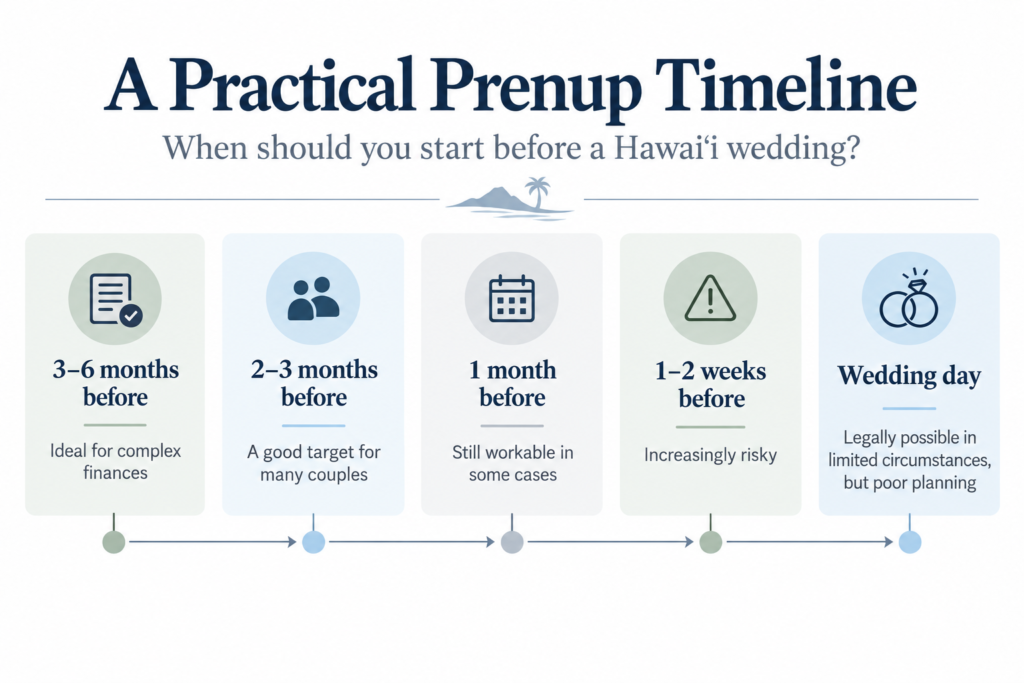
Three to six months before the wedding: An excellent time to begin, particularly for couples with businesses, substantial assets, trusts, family property, or complicated financial arrangements.
Two to three months before the wedding: A comfortable starting point for many couples and generally enough time to gather financial information, prepare drafts, obtain independent review, and negotiate changes.
One month before the wedding: Still potentially workable, but the parties and attorneys should move promptly.
One to two weeks before the wedding: Possible in some circumstances, but increasingly undesirable because the proximity of the wedding can create practical difficulties and potential questions about voluntariness.
The day before—or day of—the wedding: Hawaiʻi law does not automatically invalidate an agreement because it was signed at the last minute, but deliberately waiting this long is very poor planning, and should be avoided.
The goal should not be to determine how late you can sign a prenup.
The better question is:
How much time do we need to prepare an agreement thoughtfully and fairly?
Starting Early Can Help Protect the Agreement Later
Most couples preparing a prenuptial agreement are understandably focused on what the agreement says.
But how the agreement was created can also become important.
Years later, if the agreement is challenged during a divorce, the court may hear very different accounts of what happened before it was signed.
One spouse may say:
“We discussed it for months, exchanged financial information, each had an attorney, negotiated several provisions, and signed it well before the wedding.”
The other scenario might be:
“I first saw it a few days before the wedding and was told to sign it or cancel everything.”
Those are very different factual records.
Beginning early can help demonstrate that the agreement was the product of deliberate planning rather than last-minute pressure.
The Bottom Line: How Far Before Your Hawaiʻi Wedding Should You Get a Prenup?
There is no fixed Hawaiʻi deadline requiring a prenup to be signed a particular number of days before marriage. The agreement must be in writing and signed by both parties, and voluntariness is an important consideration in determining enforceability.
As a practical matter, however, starting approximately two to three months before the wedding is a good target for many couples, and earlier may be appropriate for more complicated financial situations.
If your wedding is closer than that, it does not necessarily mean you are too late.
It does mean that you should begin the process promptly.
The objective is not simply to get signatures before the ceremony.
It is to prepare an agreement that both people have had enough time to understand, consider, and enter into voluntarily.
Frequently Asked Questions
Is there a legal deadline for signing a prenup in Hawaiʻi?
No. Hawaiʻi law does not require a prenup to be signed a specific number of days before the wedding. However, signing too close to the wedding can raise questions about whether the agreement was entered into voluntarily.
Is one month before the wedding too late?
Not necessarily. A month may still provide enough time, especially if the parties have already discussed the terms, their finances are straightforward, and both have time to obtain legal advice.
Can we sign a prenup the week before the wedding?
Possibly, but it is generally better to avoid waiting that long. Last-minute agreements can create practical problems and may later invite arguments about pressure, inadequate review time, or lack of independent legal advice.
How early should we start preparing a prenup?
For many couples, starting two to three months before the wedding is a reasonable target. Couples with businesses, trusts, significant assets, or complicated financial arrangements may want to begin earlier.
What if our wedding is coming up soon?
Do not assume it is automatically too late. Speak with a Hawaiʻi prenuptial agreement attorney promptly so there is as much time as possible for financial disclosure, review, negotiation, and independent legal advice.
More About Hawaiʻi Prenuptial Agreements
- Financial Disclosure for Hawaiʻi Prenups
- Can a Prenup Be Thrown Out in Hawaiʻi?
- Why Marrying Couples Need Prenuptial Agreements
Talk to a Hawaiʻi Prenuptial Agreement Attorney
Since 1995, Gavin Doi has handled hundreds of premarital agreements in Hawaiʻi, including drafting prenuptial agreements, reviewing agreements prepared by other attorneys, and litigating disputes over the validity and enforceability of prenups in divorce cases.
That litigation experience provides an important perspective when preparing an agreement. Having seen how prenuptial agreements are challenged in court helps identify the issues that can matter years later—including financial disclosure, voluntariness, timing, independent legal advice, and the clarity of the agreement itself.
Gavin has also been invited to speak on prenuptial agreements to both the Family Law Section of the Hawaiʻi State Bar Association and the Maui Family Bar.
If you are considering a prenuptial agreement, Doi/Luke, Attorneys at Law can help you prepare an agreement that reflects your goals while giving careful attention to the issues that may affect its enforceability in the future.
Contact us to schedule a consultation about a Hawaiʻi prenuptial agreement.
Disclaimer
This article provides general information about Hawaiʻi law and is intended for educational purposes only. It should not be considered legal advice or relied upon as a substitute for advice from an attorney regarding your particular circumstances. Laws, court procedures, and legal standards may change, and the application of the law depends on the specific facts of each case. Reading this article or contacting Doi/Luke, Attorneys at Law through this website does not, by itself, create an attorney-client relationship. If you need legal advice regarding your individual situation, you should consult with a qualified attorney.