

Child custody and visitation are often among the most important—and most difficult—issues parents face when a relationship ends. Decisions about where a child will live, how parents will share time with the child, and who will make major decisions can affect a family for years.
Hawaiʻi courts decide custody and visitation based on the best interests of the child. The focus is not on rewarding one parent or punishing the other, but on developing an arrangement that protects the child’s safety, stability, relationships, and overall well-being.
Doi/Luke, Attorneys at Law has represented parents in Hawaiʻi family law matters since 1995. Our attorneys handle child custody and visitation issues arising in divorce, parentage, temporary restraining order proceedings, post-decree modifications, and other Family Court matters.
Some custody cases can be resolved through negotiation or mediation. Others involve significant disagreements over parenting, safety, relocation, decision-making, or a child’s needs and require litigation in Family Court. Understanding the different types of custody—and how Hawaiʻi courts approach these decisions—is an important first step.
Under Hawaiʻi Revised Statutes § 571-46, custody is determined according to the best interests of the child.
There is no automatic rule that custody goes to the mother, the father, the parent who earns more money, or the parent who previously spent more time at home. Instead, the Family Court considers the circumstances of the particular child and family. The court may also consider the value of frequent, continuing, and meaningful contact between the child and each parent, unless it finds that a parent is unable to act in the child’s best interests.
Hawaiʻi law identifies a number of factors the court considers when determining a child’s best interests (see the Hawai’i Supreme Court case, Fisher v. Fisher, 111 Haw. 41, 137 P.3d 355 (2006)). These include:
any history of sexual or physical abuse of a child by a parent;
any history of neglect or emotional abuse of a child by a parent;
the overall quality of the parent-child relationship;
each parent’s history of caregiving or parenting, both before and after the parents’ separation;
each parent’s cooperation in developing and implementing a plan to meet the child’s ongoing needs, interests, and schedule;
the child’s physical health needs;
the child’s emotional needs;
the child’s safety needs;
the child’s educational needs;
the child’s need for relationships with siblings;
each parent’s actions demonstrating that they allow the child to maintain family connections through family events and activities;
each parent’s actions demonstrating that they separate the child’s needs from their own;
any evidence of past or current drug or alcohol abuse by a parent;
the mental health of each parent;
the areas and levels of conflict present within the family; and
a parent’s prior willful misuse of the protective order process (HRS chapter 586) to gain a tactical advantage in a custody case.
The court may consider other circumstances as well. No single factor necessarily determines the outcome.
If a child is of sufficient age and capacity to reason to form an intelligent preference, the court must also consider the child’s wishes and give them due weight. This does not mean that a child reaches a particular age and is then allowed to choose which parent to live with. The child’s maturity, reasoning, circumstances, and the other best-interest factors remain important.
Hawaiʻi law also gives particular importance to family violence. If the court determines that a parent has committed family violence, a rebuttable presumption arises that placing the child in that parent’s sole custody, joint legal custody, or joint physical custody is detrimental to the child and not in the child’s best interests. In those cases, the safety and well-being of the child and of the parent who is the victim of family violence are the court’s primary considerations; the cooperation and family-connection factors listed above are not considered; and a parent who leaves or relocates because of the other parent’s family violence is not to be penalized for that absence or relocation.
Two separate forms of custody generally need to be addressed: physical custody and legal custody.
Physical custody concerns where the child lives and how the child’s time is divided between the parents.
A parent may have sole physical custody, with the other parent receiving visitation or parenting time. Parents may instead share joint physical custody, with the child spending substantial time living in each parent’s household.
Joint physical custody does not necessarily mean an exact 50/50 division of time. Parenting schedules can be structured in many different ways depending on factors such as the child’s age, school schedule, parents’ work schedules, distance between the households, extracurricular activities, and the child’s particular needs.
For child support purposes, the Hawaiʻi Child Support Guidelines use the number of overnights a child spends with each parent. The current (2024) Guidelines distinguish among sole physical custody, extensive time-sharing, and equal time-sharing for purposes of calculating support. Those child-support classifications should not be confused with the Family Court’s broader determination of legal and physical custody.
Legal custody concerns who has authority to make significant decisions affecting the child.
These decisions commonly involve matters such as:
education and schooling;
significant medical and dental care;
counseling or mental-health treatment;
religious upbringing; and
other major decisions affecting the child’s health, education, and general welfare.
Legal custody may be sole or joint.
With sole legal custody, one parent generally has the authority to make major decisions for the child. With joint legal custody, both parents share decision-making responsibility.
Joint legal custody can work well when parents are able to exchange information, discuss major issues, and make important decisions together. When parents repeatedly reach an impasse on significant matters—or where domestic violence, safety concerns, or other serious circumstances are present—the court may determine that joint legal custody is not appropriate.
Legal custody and physical custody are separate issues. For example, parents can share joint legal custody even though one parent has sole physical custody and the other parent has visitation.
Legal custody, by itself, does not determine the amount of child support. Child support calculations are affected by physical custody and the amount of time the child spends with each parent, along with the parents’ incomes and other factors under the Hawaiʻi Child Support Guidelines.
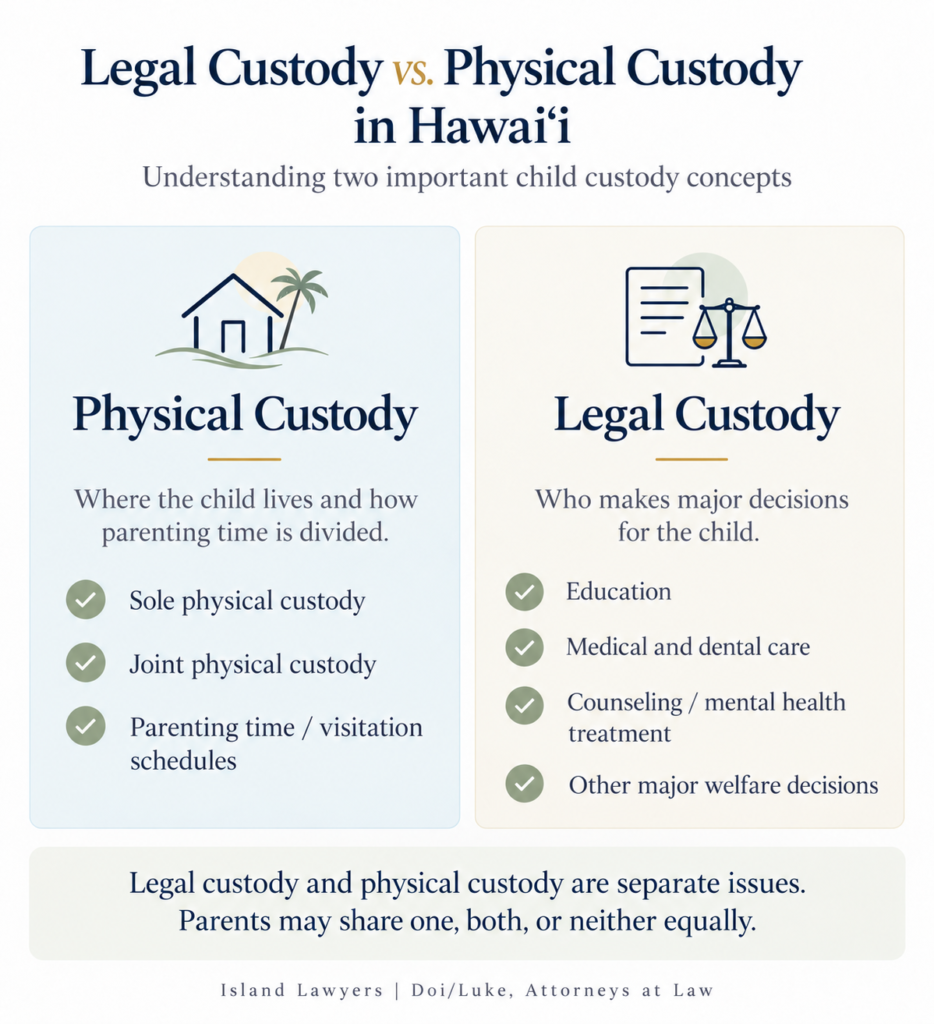
The Family Court may award sole or joint legal custody and sole or joint physical custody in different combinations.
For example:
one parent may have sole legal and sole physical custody;
one parent may have sole physical custody while the parents share joint legal custody;
the parents may share both joint legal and joint physical custody; or
the court may develop another arrangement appropriate to the circumstances of the child and family.
There is no single parenting schedule that works for every family.
Some parents divide parenting time approximately equally. Others use a school-week/weekend arrangement, alternating weekends, extended holiday and summer schedules, or other combinations. For families living on different islands—or in Hawaiʻi and on the mainland—a parenting plan may need to address airfare, school breaks, transportation, communication, and longer blocks of parenting time.
The appropriate arrangement depends on the child’s best interests rather than on achieving mathematical equality between the parents.
No. An award of custody to one parent does not, by itself, terminate the other parent’s legal relationship with the child.
Depending on the court’s orders and the circumstances of the case, a parent who does not have custody will likely have rights to visitation or parenting time, telephone or electronic contact, and access to information concerning the child.
Those rights are not unlimited. The Family Court may restrict or impose conditions on visitation when necessary to protect a child’s best interests. In serious cases involving safety concerns, domestic violence, abuse, substance abuse, or other risks, visitation may be supervised or otherwise limited.
Termination of parental rights is a very different legal matter. It generally occurs only through proceedings brought specifically for that purpose, such as certain child-welfare or adoption cases—not as part of an ordinary custody decision.
For most separated parents, the end of the adults’ relationship does not mean the end of the child’s relationship with either parent. One of the Family Court’s central concerns is developing an arrangement that serves the child’s interests while preserving appropriate parent-child relationships.
Child custody disputes can become some of the most difficult cases in Family Court.
Parents may disagree about where a child should live, how parenting time should be divided, schooling, medical care, relocation, a parent’s new relationship, substance abuse, domestic violence, mental-health concerns, or the child’s changing needs.
When parents cannot reach an agreement, the court may be required to decide those issues after considering testimony, documents, witnesses, and other evidence.
In some contested cases, the court may appoint a child custody evaluator to investigate the circumstances of the family and provide a report concerning custody. A guardian ad litem may also be appointed in appropriate cases to represent the interests of the child.
Custody litigation can be expensive and stressful for both parents and children. At the same time, some disputes involve issues that cannot responsibly be resolved simply by compromising. Allegations involving abuse, domestic violence, substance abuse, neglect, serious instability, or interference with a child’s relationship with a parent may require careful investigation and presentation of evidence.
Parents involved in custody litigation should remember that, after the court case ends, they will ordinarily continue to share an important connection through their child. Whenever possible and safe, keeping the child’s needs separate from the parents’ conflict can benefit both the child and the parents.
When one parent has sole physical custody, the other parent will commonly have a schedule for visitation, sometimes referred to as parenting time or time-sharing.
Under HRS § 571-46, reasonable visitation rights are to be awarded to parents unless it is shown that visitation would be detrimental to the child’s best interests. What is “reasonable” depends on the circumstances.
A parenting schedule may address:
weekdays and weekends;
school holidays and vacations;
summer breaks;
birthdays and special occasions;
Mothers Day and Fathers Day;
transportation and exchanges;
telephone and video contact;
travel;
out-of-state or inter-island parenting time; and
other issues specific to the family.
Some court orders contain a detailed schedule. Others allow parents substantial flexibility to arrange parenting time by mutual agreement.
A flexible arrangement can work well when parents communicate effectively. When communication is difficult, however, a more specific schedule may reduce future disagreements by establishing clear expectations regarding exchanges, holidays, vacations, and other parenting issues.
Although sample schedules and guidelines can be useful starting points, there is no single “standard visitation schedule” that the Family Court must impose. A parenting plan should be tailored to the child’s age, needs, school schedule, activities, relationship with each parent, geographic circumstances, and other relevant factors.
For child-support calculations, the number of overnights may also be important. Under the 2024 Hawaiʻi Child Support Guidelines, 143 or fewer overnights per year for the other parent is treated as sole physical custody, more than 143 but fewer than 183 overnights is considered “extensive time-sharing,” and approximately 183 overnights for each parent is considered equal time-sharing. These classifications affect the applicable child-support worksheet; they do not by themselves determine what custody arrangement is in a child’s best interests.
Supervised visitation is parenting time that takes place in the presence of an approved third person or through a supervised visitation program.
A court may order supervised visitation when there are concerns about a child’s physical or emotional safety or about a parent’s ability to care for the child without supervision. Depending upon the case, concerns may involve domestic violence, substance abuse, mental-health issues, abuse or neglect allegations, a lengthy absence from the child’s life, or other circumstances affecting the child’s welfare.
The supervisor might be an appropriate relative or other approved individual. Professional supervised visitation services may also be used, including programs offered through Parents And Children Together (PACT).
Supervised visitation does not necessarily mean that visitation will remain supervised permanently. Depending on the reason supervision was ordered, a parent may later seek expanded or unsupervised parenting time if circumstances support the change and it is in the child’s best interests.
Hawaiʻi law provides additional protections when a court has found family violence. Depending upon the circumstances, the court may order supervised visitation, protected exchanges, restrictions involving alcohol or controlled substances, restrictions on overnight visitation, or other conditions necessary to protect the child and the victim of family violence.
Not every custody disagreement needs to become a contested trial.
When appropriate—and when safety concerns do not make the process unsuitable—parents may consider several methods of resolving their disagreements.
Mediation. A neutral mediator helps the parents identify disputed issues, communicate about possible solutions, and attempt to reach an agreement. The mediator does not act as the judge and ordinarily does not decide the dispute. Some parents use community mediation programs such as the Mediation Center of the Pacific, while others work with private family-law mediators.
Counseling. Individual counseling or family counseling may sometimes help a parent address communication, adjustment, conflict, or other issues affecting the family.
Parent education. In divorce and custody cases involving children, the Family Court commonly requires parents to complete a parent-education program (on Oʻahu, the Kids First program). These programs focus on helping children cope with separation and on reducing the effect of parental conflict on children.
Co-parent or parent counseling. Parenting-focused counseling can help parents develop better ways to communicate about their child, establish boundaries, and keep adult conflict separate from parenting decisions. This can be particularly useful when parents will need to coordinate with each other for many years.
Custody Evaluation. In more contested custody cases, the Court may appoint a qualified child custody evaluator to conduct an independent investigation and provide information concerning the child’s best interests. The evaluator may interview the parents and children, review documents, speak with teachers, counselors, family members, or other collateral sources, and observe parent-child interactions when appropriate. The evaluator then prepares a written report for the Court. Hawaiʻi maintains a registry of private child custody evaluators, although the evaluators are independent and are not employees of the Family Court.
Parenting coordination. In appropriate high-conflict cases, parents may use a parenting coordinator to assist with communication and implementation of a parenting plan. The authority and role of the parenting coordinator depend upon the particular agreement or court order.
Parents should remember that an agreement concerning custody should focus on more than simply dividing days on a calendar. A workable parenting plan should anticipate the practical issues that are most likely to generate disagreements and provide enough structure to allow both parents—and most importantly the child—to know what to expect.
Custody and visitation disputes can arise when parents first separate, during a divorce or parentage case, or years after an existing order has been entered.
If circumstances have changed, an existing custody or visitation order may sometimes be modified. Under Hawaiʻi law, a custody order is subject to modification when the best interests of the child require or justify a change.
Common issues include:
a parenting schedule that is no longer working;
relocation to another island or state;
repeated interference with parenting time;
disputes involving school or medical decisions;
changes in a child’s needs;
domestic violence or safety concerns;
substance abuse;
significant conflict over joint legal custody; or
changes in a parent’s circumstances.
There is not a separate rule requiring a parent to prove a “material change in circumstances” before the Family Court may consider the child’s best interests. The Hawaiʻi Supreme Court clarified this in Waldecker v. O’Scanlon (2016). Changes in circumstances remain highly relevant, however, because a court considering modification will want to understand what has happened since the existing order and why a different arrangement would now better serve the child.
The attorneys at Doi/Luke, Attorneys at Law have represented parents in Hawaiʻi child custody and visitation matters since 1995. We handle negotiated parenting agreements as well as contested custody cases involving complex factual and legal issues. We represent clients in Honolulu, on Hawaiʻi Island, and throughout the State of Hawaiʻi.
If you would like to discuss a child custody, visitation, relocation, or modification issue with an experienced Hawaiʻi family law attorney, contact Doi/Luke at (808) 593-2199 or contact us through our website to schedule a consultation.
This page is provided for general informational purposes only and should not be construed as legal advice. Every child custody matter depends upon its particular facts and circumstances. If you need legal advice about your situation, consult a qualified attorney.
If you would like to talk to an experienced child custody lawyer Hawaii, please e-mail or call us at (808) 593-2199.