

Adoption creates a permanent legal parent-child relationship. For many Hawaiʻi families, the court process formalizes a relationship that has existed for years: a stepparent who has helped raise a child, grandparents caring for a grandchild, or relatives who have become a child’s day-to-day parents. Other adoptions involve placing a child with a new family through an agency, the foster-care system, or a private arrangement. Hawaiʻi law also permits the adoption of adults.
Whatever the circumstances, adoption is more than a name change or a custody arrangement. Once an adoption is granted, the adoptive parent generally takes on all the legal rights and responsibilities of a parent, including custody, decision-making, support, and inheritance.
Adoptions in Hawaiʻi are governed primarily by Hawaiʻi Revised Statutes (HRS) Chapter 578 and are granted by the Family Court.
Doi/Luke, Attorneys at Law has helped Hawaiʻi families with adoptions since 1995, including stepparent adoptions, relative adoptions, and both consent and non-consent proceedings.
A final adoption decree establishes a legal parent-child relationship between the adopted person and the adoptive parent or parents.
Under Hawaiʻi law, the adopted person and the adoptive parent generally have the same rights and responsibilities toward one another as a biological parent and child, including inheritance rights. The legal rights and duties between the adopted person and the former legal parent or parents generally end when the adoption takes effect.
Stepparent adoptions are the main exception. The child’s legal relationship with the parent who is married to the adopting stepparent continues unchanged. The adoption adds the stepparent as a legal parent and ordinarily ends the legal relationship with the other parent.
An adoption can affect:
legal parentage;
inheritance rights;
the child’s legal family relationships;
the child’s name; and
official records of the child’s parentage.
Because these consequences are permanent, the Family Court must approve every adoption.
Under HRS §578-1, a petition for adoption may be filed by:
an unmarried adult;
a person married to one of the child’s legal parents (a stepparent adoption); or
a married couple adopting jointly.
The petition is filed in the Family Court of the appropriate circuit. Depending on the circumstances, venue may be based on where the petitioner lives or is stationed in military service, where the person being adopted lives or was born, or where an authorized child-placing organization with legal custody is located.
In every case, the Family Court must find that the adoption meets the legal requirements and is in the best interests of the person being adopted.
A stepparent adoption occurs when a person adopts their spouse’s child. It is one of the most common types of adoption our office handles.
Many stepparents already function as parents in every practical sense: attending school events, helping with homework, providing financial support, and caring for the child as part of the family. Adoption makes that relationship legal. Once the adoption is complete, the stepparent acquires the legal rights and responsibilities of a parent, and the child’s relationship with the stepparent’s spouse remains intact.
The central issue in most stepparent adoptions is the child’s other legal parent. In many cases that parent consents. In others, consent is disputed or the parent is difficult to locate.

Grandparents, aunts, uncles, and other relatives sometimes raise a child for years and eventually seek to adopt. A relative adoption gives the child greater permanence and gives the adopting relatives full parental authority.
Common situations include:
grandparents who have raised a grandchild for years;
an aunt or uncle caring for a niece or nephew;
relatives who stepped in because a parent could not provide a stable home; or
a family that wants a permanent legal arrangement after years of informal caregiving.
Relative adoptions often involve the same consent and notice issues as stepparent adoptions. Families in this situation should also consider whether guardianship might better fit their goals (see Adoption Versus Guardianship below).
Some children are adopted through a licensed child-placing agency or after involvement with the Hawaiʻi Department of Human Services. These cases may involve additional agency requirements, home studies, placement procedures, and child-protective proceedings. When adoption is the permanent plan in a child-welfare case, additional statutes and procedures may apply before the adoption petition is granted.
Hawaiʻi law also allows an adult to be adopted. Adult adoption is often used to formalize a long-standing parent-child relationship that was never made legal during childhood.
An adult adoption requires the written, notarized consent of the adult being adopted and, if that adult is married, of the adult’s spouse. Because the person being adopted is an adult, the parental-consent, custody, and child-support issues involved in adopting a minor generally do not apply.
Consent is often the central legal issue in an adoption.
HRS §578-2 identifies whose consent is required. Depending on the circumstances, this can include the child’s legal parents, any person or agency with legal custody of the child, and others whose parental status is legally recognized.
A child who is more than ten years old must also consent, unless the Family Court finds that dispensing with the child’s consent is in the child’s best interests.
Notarization is now required. Under Act 5 of the 2026 Legislature, effective April 28, 2026, written consents to adoption must be notarized. Consents signed before that date, or signed without a notary, should be reviewed before they are filed.
In a consent adoption, everyone whose consent is legally required signs the necessary consent forms. In a typical stepparent adoption, for example, the child’s other parent agrees to the adoption and signs a notarized consent.
Consent makes the process considerably simpler because the court does not have to decide whether that parent’s consent can be dispensed with. Even so, the petition and supporting documents must still be prepared and filed, the legal requirements must be met, and the Family Court must approve the adoption.
No. Hawaiʻi law identifies circumstances in which a parent’s consent is not required, and others in which the Family Court may dispense with it. This is an area where the specific facts matter a great deal.
For example, HRS §578-2 provides that consent is not required from a parent of a child in another person’s custody who, when able to do so, has:
failed for at least one year to communicate with the child; or
failed for at least one year to provide for the child’s care and support.
Other provisions address desertion, voluntary surrender of custody, previously terminated parental rights, certain questions of parental status, and incapacity, among other circumstances.
These are not boxes on a checklist. The one-year provisions do not mean that every parent who has had limited contact or paid little support automatically loses the right to consent. Disputes often turn on whether the parent was actually able to communicate with or support the child, whether contact or indirect support occurred, what custody arrangements were in place, and whether each statutory requirement can be proven.
For these reasons, non-consent adoptions are usually considerably more involved than agreed adoptions.
A parent who cannot be found cannot simply be ignored.
If a parent described in the consent statute has not consented, Hawaiʻi law generally requires that the parent receive notice of the petition and hearing, unless that parent’s rights have already been terminated or another exception applies. When a parent cannot be located, the petitioner may need to show reasonable efforts to find them and ask the court to approve an alternative form of notice, such as service by mail, service outside Hawaiʻi, or publication.
What notice is required depends on the facts and on the parent’s legal status. That is one reason to raise a missing-parent problem at the start of the case, not after the petition has been prepared.
Every case is different, but most Hawaiʻi adoptions follow the same general sequence.
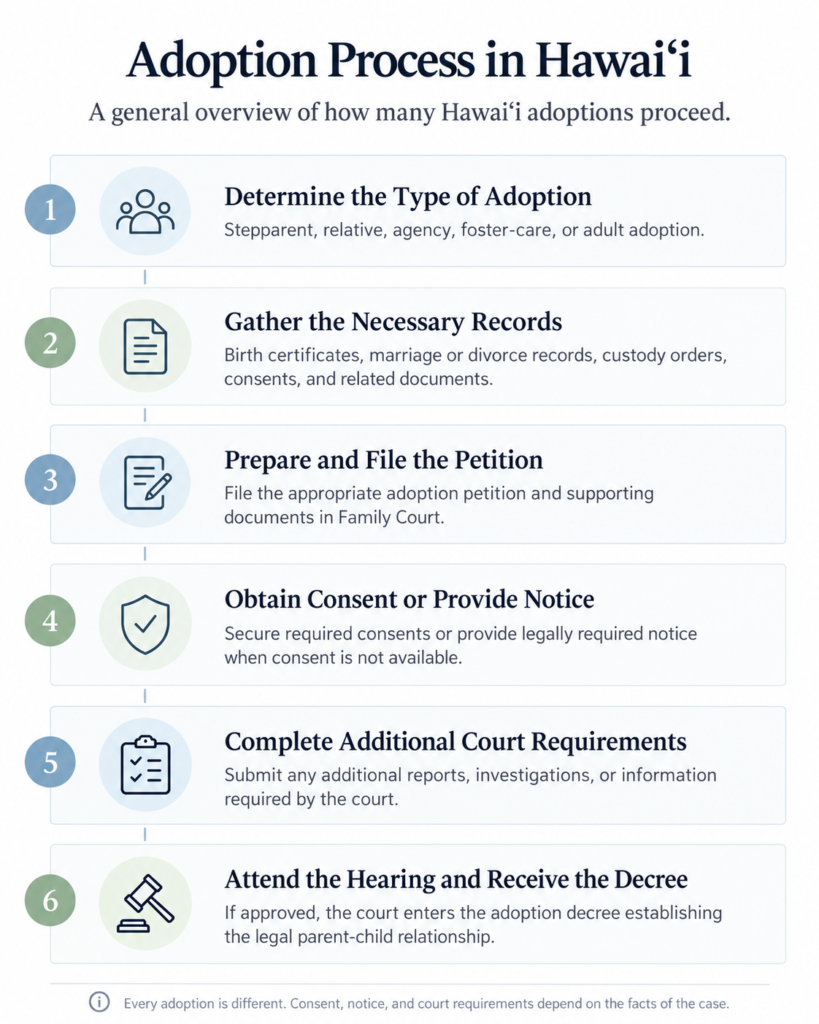
The first step is understanding the family relationships and the legal status of everyone involved. Key questions include:
Who are the child’s current legal parents?
Is there an existing custody or guardianship order?
Is the person adopting a stepparent, a relative, or someone else?
Does the other parent agree to the adoption?
Have any parent’s rights already been terminated?
Can every necessary party be located?
Is the child old enough that the child’s own consent is required?
The answers usually show early on whether the case is likely to proceed as a consent or a contested adoption.
Adoptions require more documentation than many families expect. Depending on the case, this may include:
the child’s certified birth certificate;
marriage certificates and divorce decrees;
custody or guardianship orders;
death certificates;
signed consent forms;
records of prior paternity or parentage proceedings;
medical information required by the court;
records from any child-welfare proceedings; and
other records concerning the parties’ legal relationships.
The petition and supporting documents are filed with the Family Court. The Hawaiʻi State Judiciary maintains separate forms and procedures for different adoption matters, including consent and non-consent adoptions. The petition gives the court the factual and legal basis for the adoption.
In a consent adoption, properly signed and notarized consents are filed with the court. If someone whose rights are affected has not consented, the petitioner must determine what notice is required and whether there is a legal basis to proceed without that person’s consent. In contested cases, this stage can become the most significant part of the proceeding.
Depending on the type of adoption, the court may require additional documents, reports, investigations, medical information, or other evidence. Agency and child-welfare adoptions often involve requirements that a straightforward stepparent adoption does not.
Hawaiʻi law requires a hearing before an adoption decree is entered. At the hearing, the Family Court reviews the petition and supporting evidence. Among other things, the court must be satisfied that:
the person is legally eligible to be adopted;
the adoption is appropriate;
the adopting parent or parents are fit and proper persons and, when a child is being adopted, financially able to provide a proper home and education; and
the adoption is in the best interests of the person being adopted.
Those whose attendance is required ordinarily must appear unless the court excuses them.
If the court grants the petition, it enters a decree establishing the new legal parent-child relationship. The decree can also change the adopted person’s name, if requested. Once the decree takes effect, the adoptive parent and the adopted person have the full legal rights and responsibilities of parent and child.
After an adoption, the court’s information is forwarded so that vital records can reflect the adoption. For a child born in Hawaiʻi, this generally means the Department of Health issues a new birth certificate naming the adoptive parent or parents. For a child born in another state or country, the process depends on that jurisdiction’s rules.
Yes. A name change can generally be requested as part of the adoption itself. Some families change the child’s surname to match the adoptive family; others keep the child’s existing name. A name change is not required.
No. Adoption proceedings receive strong privacy protection. Under HRS §578-15, adoption hearings are generally held in chambers rather than in open court, and access to the court file is restricted. Once the case is completed, the records are sealed, subject to statutory procedures governing later access. This is a notable difference from many other Family Court matters.
Adoption creates a permanent legal parent-child relationship. The adoptive parent becomes the child’s legal parent, and the legal relationship with the former parent ordinarily ends (except in stepparent adoptions, as described above).
Guardianship gives a guardian legal authority over and responsibility for a child without permanently replacing the child’s parents.
Guardianship may be the better choice when:
a parent is temporarily unable to care for the child;
the family wants the parent-child relationship to remain legally intact;
circumstances may change in the future; or
permanent adoption is not appropriate or desired.
Adoption is usually the better choice when the goal is a permanent parental relationship. Which option fits depends on the family’s circumstances and long-term goals.
No. Hānai relationships hold an important place in Hawaiʻi families and culture, but an informal hānai relationship is not a legal adoption, and it does not by itself give the caregiver the legal rights of a parent.
Families may consider formal adoption when they want the caregiver to have full parental rights and responsibilities. This matters most when questions arise about medical decisions, school matters, inheritance, government benefits, or other situations in which legal parentage controls.
There is no single timeline. A straightforward stepparent adoption in which everyone consents usually moves much faster than a contested case.
Timing may depend on:
whether all necessary parties consent;
whether a parent must be located or served;
whether service by publication is necessary;
whether the adoption is contested;
how quickly required records can be obtained;
whether an investigation or additional report is required; and
the Family Court’s hearing schedule.
Often, but not always. Hawaiʻi law identifies circumstances in which a parent’s consent is not required or may be dispensed with. The answer depends on the parent’s legal status, the history of contact and support, and the specific facts of the case.
A child who is more than ten years old generally must consent, unless the Family Court finds that dispensing with the child’s consent is in the child’s best interests.
Yes. Since April 28, 2026, Hawaiʻi law requires written consents to adoption to be notarized.
Possibly. A missing parent cannot simply be ignored. The family may need to show reasonable efforts to locate the parent and meet the court’s notice requirements before the adoption can proceed.
Yes. Grandparents, aunts, uncles, and other relatives may adopt when the legal requirements are met. A relative adoption gives the child a permanent legal parent-child relationship and gives the adopting relative full parental rights and responsibilities.
Adoption creates a permanent legal parent-child relationship. Guardianship gives another adult authority to care for a child without permanently replacing the child’s legal parents. Which is more appropriate depends on the family’s circumstances and long-term goals.
There is no single timeline. A straightforward consent adoption may move relatively quickly, while a case involving a missing or non-consenting parent, contested parental rights, or additional notice requirements can take considerably longer.
Adoption can be one of the most meaningful proceedings in Family Court, but the legal requirements vary considerably with each family’s circumstances.
If you are considering an adoption, or have questions about consent, notice, parental rights, or the process, contact Doi/Luke, Attorneys at Law at (808) 593-2199 or through our website to schedule a consultation.
We represent families on Oʻahu, Hawaiʻi Island, and throughout the State of Hawaiʻi.
This article is provided for general informational purposes only and should not be construed as legal advice. Every family law case depends on its particular facts and circumstances. If you need legal advice about your situation, consult a qualified attorney.