

When a child is being raised by someone other than a parent, families often assume that guardianship and adoption accomplish the same thing.
Key takeaways:
- Adoption creates a new, permanent legal parent-child relationship; guardianship does not.
- A guardianship can be modified or ended by the court and generally ends when the child turns 18; adoption does not expire.
- In 2026, the Hawaiʻi Supreme Court confirmed that a parent’s rights can survive even after the parent consents to a guardianship.
What Is a Guardianship of a Child in Hawaiʻi?
A guardianship allows someone other than a child’s parent to take on substantial responsibility for the child’s care.
Under Hawaiʻi law, the Family Court may appoint a guardian for a minor when the appointment serves the child’s best interests and:
- the parents consent;
- parental rights have been terminated; or
- the parents are unwilling or unable to exercise their parental rights.
See HRS § 560:5-204.
Unless the court limits the guardian’s authority, a guardian generally has the powers of a parent over the child’s support, care, education, health, and welfare. A guardian may typically take custody of the child, establish the child’s residence, consent to medical treatment, and make many of the day-to-day decisions a parent would normally make. See HRS § 560:5-208.
This can make guardianship a useful arrangement when a child’s parents are temporarily or indefinitely unable to provide appropriate care. For example, a grandparent might become guardian while a parent works through serious instability and the child needs a safe, consistent home.
But the grandparent does not automatically become the child’s legal parent simply by being appointed guardian.
Does Guardianship Terminate the Parents’ Rights?
No — and this is one of the most important differences between guardianship and adoption.
A guardianship can transfer substantial authority over a child to the guardian while leaving the underlying parent-child relationship intact.
In a significant 2026 decision, the Hawaiʻi Supreme Court held that a parent’s constitutional interest in raising their child continues even after the parent has consented to a guardianship. The court held that the presumption that a fit parent acts in the child’s best interests survives that consent — agreeing to a guardianship is not the same as permanently surrendering parental status. In re Guardianship of I.W. and T.E., SCWC-23-0000356 (Haw. June 16, 2026).
That case illustrates an important feature of guardianship: it can provide stability for a child without necessarily replacing the child’s parents on a permanent basis.
How Long Does a Guardianship Last?
A guardianship of a minor doesn’t necessarily last forever. Under HRS § 560:5-210, a minor guardianship terminates upon:
- the child’s death;
- adoption;
- emancipation;
- reaching the age of majority; or
- an order of the court.
A child, parent, guardian, or other interested person may return to court when circumstances change. See HRS § 560:5-210. This potential for later modification or termination is another major distinction between guardianship and adoption.
What Is Adoption in Hawaiʻi?
Adoption goes considerably further than guardianship. When an adoption is completed, the adoptive parent becomes the child’s legal parent.
Hawaiʻi law provides that an adopted child and the adoptive parent have the legal relationship of parent and child, including the rights and responsibilities ordinarily associated with that relationship. The adopted child also generally acquires inheritance rights through the adoptive family. See HRS § 578-16.
Unlike guardianship, adoption does not ordinarily end when the child turns 18. A seven-year-old who is adopted becomes the adoptive parent’s legal child — and that relationship remains intact whether the child is 18, 30, or 60.
That permanence is often one of the main reasons families choose adoption.
What Happens to the Biological Parents’ Rights After Adoption?
As a general rule, adoption ends the legal rights and duties between a child and the child’s former legal parent or parents.
There are important statutory exceptions, particularly for certain stepparent and relative adoptions. For example, when a stepparent adopts the child of their spouse, the child’s legal relationship with that spouse-parent continues. Hawaiʻi law also contains special provisions for certain adoptions by relatives. See HRS § 578-16(d)-(e).
This is quite different from an ordinary guardianship, where the parents’ underlying parental status typically remains intact.
Consider a common situation: a child has lived with her grandparents for several years because her parents cannot care for her.
If the grandparents obtain guardianship, they may be able to make educational, medical, and other important decisions for the child — but the parents continue to have parental rights.
If the grandparents adopt the child, however, they become the child’s legal parents, subject to the specific statutory rules that apply to that adoption.
Is Parental Consent Required?
Consent issues can arise in both proceedings, but they work differently.
Guardianship
As noted above, Hawaiʻi law permits a guardian to be appointed when the parents consent, when their parental rights have already been terminated, or when the parents are unwilling or unable to exercise their parental rights. See HRS § 560:5-204. Accordingly, a guardianship can sometimes be established even when a parent does not affirmatively agree to it.
Adoption
Adoption ordinarily requires consent from the persons identified in HRS § 578-2, unless one of the statutory grounds exists under which consent is unnecessary or may be dispensed with.
As of 2026, Hawaiʻi also requires written consent to adoption to be notarized — a requirement enacted through Act 5 of the 2026 Legislature.
Whether a parent’s consent is required — or whether an adoption can proceed without it — can become one of the most important legal issues in an adoption case.
When Might Guardianship Make More Sense?
Guardianship may be appropriate when everyone agrees the child needs another caregiver, but the family does not intend to permanently replace the child’s parents.
A Parent Is Temporarily Unable to Care for the Child
A parent may be dealing with illness, instability, military deployment, treatment, incarceration, or another circumstance that prevents them from providing day-to-day care. If the expectation is that the parent may eventually resume parenting, guardianship can provide the child with needed stability without the permanence of adoption.
The Family Wants to Preserve the Parent-Child Relationship
Sometimes grandparents or other relatives are willing to raise a child but don’t want to legally become the child’s parents. They may want the child’s mother or father to remain legally recognized as the parent while the guardian handles the child’s everyday needs.
The Future Is Uncertain
A guardianship can provide structure now while leaving room for the court to reconsider the arrangement if circumstances materially change. That flexibility can be an advantage — but it can just as easily be a disadvantage when a family wants long-term certainty.
When Might Adoption Make More Sense?
Adoption may be a better fit when the parties intend the caregiver to become the child’s permanent parent.
The Child Has Been Raised by the Caregiver for Years
A grandparent, aunt, uncle, or other relative may have raised a child for most of the child’s life. Eventually, the family may conclude that the legal relationship should reflect the actual family relationship.
A Stepparent Is Functioning as a Parent
A stepparent may have lived with and helped raise a child for years. Stepparent adoption can convert that practical parental relationship into a legal one, giving the stepparent the same legal status as a parent.
The Family Wants Permanence
Guardianships can be revisited. For some families, that ongoing uncertainty becomes difficult — particularly once a child has lived in the same home for years and regards the guardian as a parent. Adoption provides greater legal permanence.
Inheritance and Long-Term Family Status Matter
Because adoption creates a legal parent-child relationship, it affects more than who can sign school forms or consent to medical treatment. It also establishes a continuing familial relationship, including significant inheritance consequences under Hawaiʻi law. See HRS § 578-16.
Can a Guardian Later Adopt the Child?
Yes, potentially. It’s not unusual for a family to begin with guardianship and later consider adoption.
For example, grandparents may initially seek guardianship because no one knows whether the child’s parent will eventually be able to resume parenting. Years later, circumstances may look very different:
- the child may have lived continuously with the grandparents;
- the grandparents may be the child’s psychological and practical parents;
- the biological parent may remain unable to provide care; and
- everyone may recognize that the arrangement is effectively permanent.
At that point, adoption may become worth considering.
Hawaiʻi law specifically recognizes that a minor’s guardianship terminates upon the child’s adoption. See HRS § 560:5-210.
A guardian does not, however, automatically have authority to consent to the child’s adoption simply by virtue of being guardian. Under HRS § 560:5-208(c), the court may specifically authorize a guardian to consent to adoption.
What About a Child’s Name and Birth Certificate?
Adoption commonly results in changes that guardianship does not. As part of an adoption, the court may change the child’s name, and the adoption process results in official records reflecting the child’s new legal parentage.
Guardianship ordinarily does not rewrite the child’s legal parentage. The guardian is appointed to care for the child but does not become a parent simply because the guardianship exists.
For families deciding between the two, that distinction can matter both legally and emotionally.
Is Guardianship “Easier” Than Adoption?
Sometimes — but that’s not necessarily the best way to frame the question.
The real issue isn’t which proceeding is easier, but which legal relationship the family actually wants. Using guardianship when everyone really intends a permanent parent-child relationship can leave a family with less certainty than they want. On the other hand, pursuing adoption when the family only needs temporary caregiving authority may create legal consequences broader than necessary.
The right choice depends on what’s happening with the child, the parents, the proposed caregiver, and the family’s long-term plans.
A Simple Way to Think About the Difference
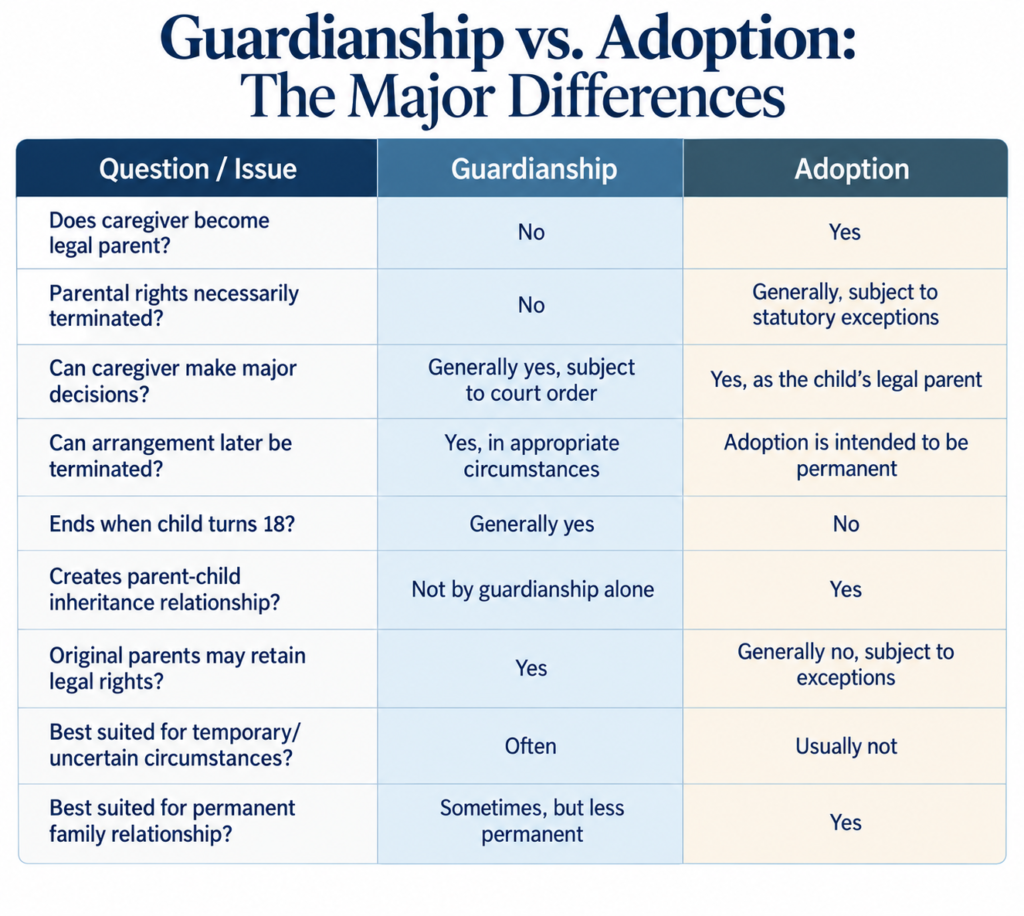
The distinction can be summarized this way: a guardian cares for the child and exercises many parental powers; an adoptive parent legally becomes the child’s parent.
That difference explains much of the rest. Guardianship is generally capable of changing or ending as circumstances change. Adoption is intended to create a permanent family relationship. Neither option is automatically better — they serve different purposes.
Frequently Asked Questions About Adoption and Guardianship in Hawaiʻi
Is guardianship the same as adoption in Hawaiʻi?
No. A guardian may have many of the same day-to-day powers as a parent, including authority over a child’s care, education, and medical decisions. But a guardian does not automatically become the child’s legal parent. Adoption creates a new legal parent-child relationship and is intended to be permanent.
Does guardianship terminate a parent’s rights?
Not necessarily. A guardianship can give another person substantial authority to care for a child while the child’s parent continues to have parental rights. Depending on the circumstances, a parent may later ask the court to terminate or modify the guardianship.
Does adoption terminate the biological parent’s rights?
Generally, yes — adoption terminates the legal rights and responsibilities of the parent whose parental relationship is being replaced, although Hawaiʻi law contains exceptions for certain stepparent and relative adoptions. The effect of an adoption therefore depends in part on who is adopting the child and the child’s existing legal relationships.
Can a guardian later adopt the child?
Potentially, yes. Some families begin with guardianship because the child’s long-term circumstances are uncertain, and later consider adoption once it becomes clear the caregiver will be raising the child permanently. Adoption requires a separate court proceeding and satisfaction of Hawaiʻi’s adoption requirements.
Does a guardianship end when the child turns 18?
Generally, yes. A guardianship of a minor ordinarily ends when the child reaches adulthood, though it may also end earlier due to adoption, emancipation, death, or a court order. Adoption, by contrast, creates a parent-child relationship that continues after the child becomes an adult.
Which is better — guardianship or adoption?
Neither is automatically better. Guardianship may make more sense when the caregiving arrangement is temporary or the future is uncertain. Adoption may make more sense when the parties intend to create a permanent legal parent-child relationship. The right choice depends on the child’s circumstances, the parents’ legal rights, and the family’s long-term plans.
Adoption or Guardianship? Talk With a Hawaiʻi Family Law Attorney
Families considering guardianship or adoption are often dealing with circumstances that developed gradually. A grandparent may have started caring for a child “for a few months” and still be raising that child years later. A stepparent may have become the only parent a child remembers living with. Or relatives may agree that a child needs a stable home but disagree about whether the arrangement should be temporary or permanent.
In those situations, the legal label matters.
Doi/Luke, Attorneys at Law assists families with adoption and other Hawaiʻi family law matters. We can help evaluate whether adoption is appropriate, explain consent and parental-rights issues, and guide families through the Family Court process.
Disclaimer: This article provides general information about Hawaiʻi law and is intended for educational purposes only. It should not be considered legal advice or relied upon as a substitute for advice from an attorney regarding your particular circumstances. Laws, court procedures, and legal standards may change, and the application of the law depends on the specific facts of each case. Reading this article or contacting Doi/Luke, Attorneys at Law through this website does not, by itself, create an attorney-client relationship. If you need legal advice regarding your individual situation, you should consult with a qualified attorney.
More About Adoption in Hawaiʻi
- The Adoption Process in Hawaiʻi: What Families Need to Know
- Stepparent Adoption in Hawaiʻi: A Guide to the Process
- Does the Other Parent Have to Consent to a Stepparent Adoption in Hawaiʻi?