
Alimony, also called spousal support or spousal maintenance, is financial support that one spouse may be ordered to pay the other during or after a divorce.
Alimony is not automatic in Hawaiʻi, and there is no statewide formula that tells a judge how much support should be paid or for how long. Instead, the Family Court weighs both spouses’ financial circumstances against a list of factors set by statute. The question is whether support is appropriate and, if so, what amount and duration would be just and equitable.

Alimony is money one spouse pays the other for support. It may be ordered while a divorce is pending, as part of the final divorce decree, or both.
The purpose of alimony is not simply to equalize the spouses’ incomes. The Family Court looks at whether one spouse needs support, whether the other spouse is able to pay, and how the statutory factors apply to that particular marriage.
Either spouse may request alimony. Hawaiʻi’s spousal-support law is gender-neutral.
No. Unlike child support, alimony is not calculated with a worksheet or a set percentage.
A spouse seeking alimony generally must show a financial need for support. The court also considers whether the other spouse can contribute toward that need while still meeting their own reasonable expenses.
A large income gap matters, but it does not by itself guarantee an award. Likewise, the fact that both spouses work does not automatically defeat an alimony claim. The court looks at the overall financial picture.
Hawaii Revised Statutes §580-47(a) lists 13 factors the Family Court must consider when deciding spousal support:
the financial resources of the parties;
the ability of the spouse seeking support to meet their needs independently;
the duration of the marriage;
the standard of living established during the marriage;
the ages of the parties;
the physical and emotional condition of the parties;
the usual occupations of the parties during the marriage;
the vocational skills and employability of the spouse seeking support;
the needs of the parties;
custodial and child-support responsibilities;
the ability of the spouse from whom support is sought to meet their own needs while paying support;
other factors that measure the financial condition in which the parties will be left after the divorce; and
the probable duration of the need for support.
More broadly, the statute also directs the court to consider the condition in which each party will be left by the divorce, any concealment of income or assets, and all other circumstances of the case.
No single factor controls. The length of the marriage, for example, can be very important, but it is weighed together with the parties’ ages, incomes, employability, assets, expenses, standard of living, and other circumstances.
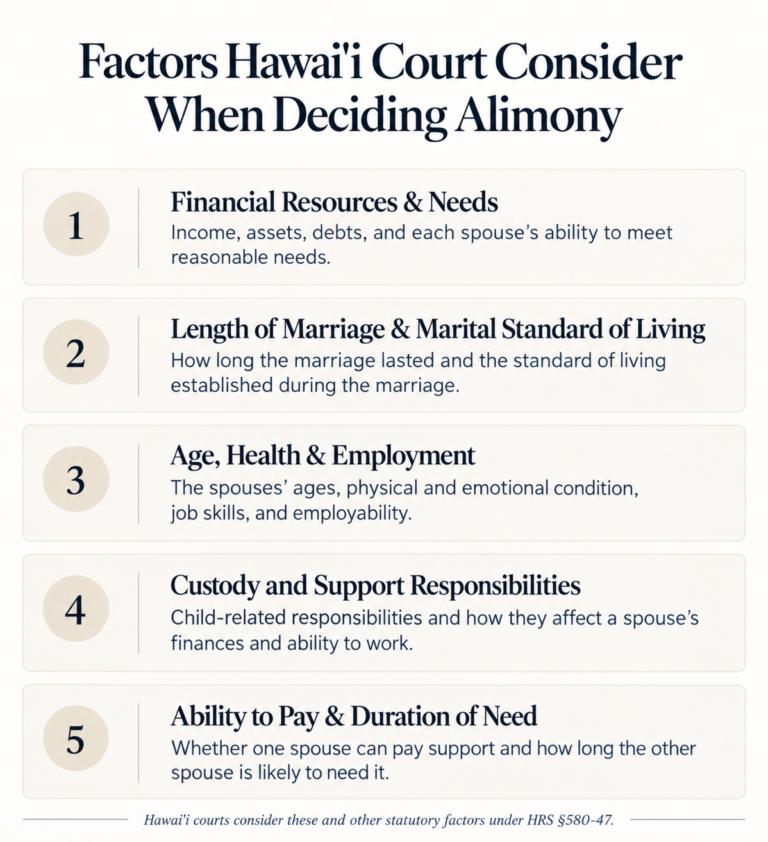
There is no formula for alimony in Hawaiʻi, which makes it less predictable than child support.
In setting an amount, the court does not award support simply because one spouse earns more, but instead focuses on:
the reasonable monthly needs of the spouse requesting support, connected to the standard of living during the marriage;
the requesting spouse’s ability to meet their needs without alimony;
the “payor” spouse’s needs, connected to the standard of living during the marriage; and
the other spouse’s ability to pay alimony after meeting their own reasonable needs.
Vorfeld v. Vorfeld, 8 Haw.App. 391, 804 P.2d 891 (1991). In practice, alimony issues turn on a careful review of each party’s Income and Expense Statement, employment history, tax returns, bank records, retirement and investment income, and other financial information.
There is no fixed rule based on the length of the marriage. Under HRS §580-47, the Family Court may order support:
for a specific period;
for an indefinite period; or
until further order of the court.
The statute specifically addresses a spouse who needs time to obtain education, training, skills, or other qualifications for appropriate employment. In that situation, the court must order support long enough to complete the training, plus enough additional time to find suitable work.
The probable duration of the recipient’s need is itself one of the statutory factors. In practice, duration may be affected by:
the length of the marriage;
how long a spouse has been out of the workforce;
age and health;
existing job skills and earning capacity;
the marital standard of living;
the assets each spouse receives in the property division; and
how long it will reasonably take the recipient to become more financially independent.
Long marriages often present different issues than short ones, but Hawaiʻi law does not use a rule of thumb such as “one year of alimony for every three years of marriage.”
Yes. Once a divorce or separation case is filed, HRS §580-9 allows the Family Court to order temporary spousal support while the case is pending, and to revise that order as circumstances change. The court may also order one spouse to advance reasonable attorney’s fees and costs to the other.
Temporary support helps a spouse meet reasonable expenses while the parties work toward settlement or trial. It is separate from the question of whether alimony should continue after the divorce. When the final decree is entered, its alimony provisions generally replace the temporary order.
Alimony is usually paid in regular monthly or semi-monthly installments. Depending on the order, payments may be made directly to the former spouse or through income withholding. The parties or the court may structure support differently when appropriate, but payments should always follow the terms of the decree or other court order.
If a party fails to pay as ordered, the recipient may ask the Family Court to enforce the order.
It is possible, but not common. Under HRS §580-47(d), either party may ask the Family Court to modify a support order based on a material change in physical or financial circumstances or other good cause. Examples include:
a significant loss of income;
retirement;
disability or serious illness;
a substantial change in the recipient’s income or financial need;
a change in employment; or
other circumstances affecting the need for support or the ability to pay.
A change in circumstances does not automatically result in a modification. The court weighs the evidence and decides whether good cause exists to revise the order. The precise wording of the divorce decree also matters.
Under HRS §580-51, unless the decree or an approved agreement specifically provides otherwise, the right to receive alimony automatically ends for all payments due after the recipient remarries.
The remarried recipient must also file a notice of the remarriage with the court and serve it on the former spouse within 30 days. A recipient who fails to do so may face consequences when the court decides attorney’s fees, costs, and reimbursement of payments made after the remarriage.
Cohabitation is different. Living with a new partner does not automatically end alimony, although the financial effects of cohabitation may be relevant to a motion to modify support.

Alimony and property division are separate legal issues, but they are closely connected. The property and debts each spouse receives in the divorce can directly affect that spouse’s need for support.
A spouse who receives substantial liquid assets or income-producing property, for example, may be in a very different position from a spouse who leaves the marriage with few available resources. For that reason, alimony is best evaluated together with the proposed property division, not in isolation.
Yes. Under Hawaiʻi’s Uniform Premarital Agreement Act (HRS Chapter 572D), spouses may address spousal support in a valid prenuptial agreement, including modifying or waiving it. There are limits: for example, if a waiver would leave a spouse eligible for public assistance at the time of divorce, the court may still require enough support to prevent that.
If there is a prenuptial agreement, it should be reviewed carefully before assuming the ordinary alimony rules apply. Whether the agreement is enforceable can itself become a disputed issue.
For federal income tax purposes, the answer depends mainly on when the divorce or separation instrument was executed.
For instruments executed after December 31, 2018, alimony is generally:
not deductible by the paying spouse; and
not taxable income to the receiving spouse.
Older instruments generally remain under the prior rules (deductible by the payor and taxable to the recipient) unless they are later modified and the modification expressly adopts the new treatment. See IRS Publication 504.
Tax treatment can significantly affect support negotiations, especially when modifying an older decree. Parties with significant tax issues should consult a tax professional.
Hawaiʻi is a no-fault divorce state. A spouse does not have to prove adultery or other misconduct to get divorced, and adultery by itself does not entitle one spouse to alimony or bar the other from receiving it. The court’s analysis focuses on the financial and personal circumstances described in HRS §580-47.
Financial misconduct is another matter. Section 580-47 expressly allows the court to consider a party’s concealment of, or failure to disclose, income or assets. In practice, how a spouse handled money can matter more than personal misconduct.
No. The length of the marriage is an important factor, but there is no automatic right to alimony based on duration alone. The court considers all of the statutory factors, including need and ability to pay.
Yes. Hawaiʻi’s spousal-support law is gender-neutral.
No. Unlike child support, Hawaiʻi has no statewide formula or official worksheet for alimony.
Yes, when appropriate. Hawaiʻi law permits support for an indefinite period or until further order of the court. The facts of the case determine the duration.
Not automatically. Remarriage ends alimony unless the decree says otherwise, but cohabitation does not. Cohabitation may, however, support a motion to modify if it changes the recipient’s financial need.
Possibly. A significant change in income or other financial circumstances may support a motion to modify, but the court must find that the legal requirements for modification are met. Act promptly: until the court modifies the order, the existing payments generally remain due.
Alimony disputes involve far more than comparing two paychecks. The court may need to weigh each spouse’s needs, earning capacity, assets, debts, employment history, age, health, marital standard of living, and the property division as a whole.
We represent clients who are seeking alimony, responding to an alimony claim, negotiating spousal support in a divorce settlement, or seeking to modify or enforce an existing order.
To discuss how Hawaiʻi alimony law applies to your situation, call Doi/Luke, Attorneys at Law at (808) 593-2199 or contact us through our website to schedule a consultation.
This page provides general information only and is not legal advice. Alimony decisions depend heavily on the facts of each case. If you need advice about spousal support or divorce, consult a qualified attorney.