

For many people on the Big Island, hiring a divorce lawyer raises a practical question:
Do I need to meet with my attorney in person, or can much of the divorce process be handled remotely?
In many cases, substantial parts of a Big Island divorce can be handled remotely. Consultations, document review, strategy meetings, settlement discussions, and case preparation can often take place by phone and video conference, with documents signed electronically and exchanged through secure online portals.
That can be especially helpful for clients in Hilo, Puna, Keaʻau, Mountain View, Kona, Waimea, Volcano, and other Big Island communities where travel, work schedules, childcare, and court logistics can make in-person meetings difficult.
At Doi/Luke, Attorneys at Law, we assist clients throughout Hawaiʻi with divorce, custody, child support, property division, and other family law matters, including clients on the Big Island.
Many Parts of a Divorce Case Can Be Handled Remotely
Modern divorce representation does not always require repeated in-person office visits.
Depending on the case, many tasks can often be handled remotely, including:
- Initial consultations;
- Follow-up meetings;
- Reviewing divorce options;
- Discussing custody and parenting concerns;
- Gathering financial information;
- Reviewing bank statements, tax returns, paystubs, and other records;
- Preparing court documents;
- Signing representation agreements and court documents electronically;
- Exchanging settlement proposals;
- Preparing for mediation;
- Preparing for hearings or trial;
- Communicating about case strategy.
For many clients, remote communication makes the process more efficient and less disruptive.
No More Mailing Original Signatures
Not long ago, many divorce documents had to be signed in ink, and the original signed pages had to be mailed or hand-delivered to the attorney’s office before they could be filed. For Big Island clients, that could mean days of waiting on the mail, or a long drive just to drop off paperwork.
Electronic filing changed that. Because Family Court documents are now filed electronically, clients generally no longer need to send original signature pages to their attorney’s office.
At Doi/Luke, virtually all of our documents may be signed electronically using DocuSign. That includes office documents, such as representation agreements, as well as court documents. Clients can review and sign from a phone, tablet, or computer, wherever they are on the island, and we can often file a signed document within minutes rather than the hours or days it once took for originals to arrive.
A small number of documents, such as those that must be notarized, may require additional steps. If your case involves one, we will let you know in advance.
Why Remote Representation Can Help Big Island Clients
Big Island clients often face practical travel realities that are different from clients living near a law office or courthouse.
Depending on where a person lives, travel may involve:
- Long drives to meetings or court—for example, between Kona and Hilo, or from Puna, Volcano, or Waimea;
- Work schedule conflicts;
- Childcare responsibilities;
- Transportation limitations;
- Inter-island travel concerns;
- Time away from work or family.
Remote representation can reduce unnecessary travel and allow clients to focus on the issues that matter most: protecting their children, finances, property, and future stability.
Do I Need a Lawyer Physically Located in Hilo?
Not necessarily.
For many clients searching for a Hilo divorce lawyer, the more important question is not whether the attorney’s main office is physically located in Hilo, but whether the attorney:
- Understands Hawaiʻi family law;
- Has experience with divorce, custody, support, and property division;
- Communicates clearly and consistently;
- Understands Big Island logistics;
- Can help prepare the client for court, mediation, and settlement discussions;
- Uses electronic signatures and secure document portals to handle documents and case preparation remotely.
A Honolulu-based family law attorney can often represent Big Island clients effectively, particularly when remote communication is organized and the attorney understands the specific logistical issues that may arise in Big Island divorce and custody cases.
When In-Person Attendance May Still Be Needed
Although many parts of a divorce case can be handled remotely, some situations may still require in-person attendance.
Depending on the court, the judge, the type of hearing, and the issues in dispute, in-person attendance may be needed for:
- Certain court hearings;
- Evidentiary hearings;
- Trial;
- Meetings involving complex exhibits or testimony preparation.
Whether a particular appearance can be handled remotely depends on the circumstances, and clients should not assume that every part of a divorce case can be completed from home. Still, for first appearances, status hearings, and mediation, remote participation by Zoom is now the norm rather than the exception.
Even when a court appearance or mediation session requires in-person participation, much of the preparation can often still be handled remotely.
Remote Divorce Representation and Big Island Family Courts
Divorce and family law cases on the Big Island are handled by the Family Court of the Third Circuit, which hears cases in Hilo (East Hawaiʻi), Kona (West Hawaiʻi), and Kamuela (North Hawaiʻi).
Attorneys file Family Court documents electronically through the Hawaiʻi State Judiciary’s e-filing system, so clients generally do not need to visit the courthouse simply to file or pick up paperwork.
In addition, many uncontested divorces—where the spouses have reached a full agreement—can be finalized based on written filings, without either spouse appearing in court.
For clients throughout the island, remote representation can help reduce the number of in-person meetings required during the case. Attorney-client communication, document preparation, financial review, and settlement planning can often be handled without repeated office visits.
This can be especially useful when a case involves:
- Divorce;
- Child custody;
- Child support;
- Spousal support;
- Property division;
- Post-divorce modification;
- Inter-island parenting issues.
Zoom Appearances Are Common in Big Island Family Court
On the Big Island, as on most Neighbor Islands, Family Court judges are accommodating to appearances by off-island attorneys. In our experience, in the vast majority of first appearances (initial hearings) on divorce and parentage motions, the court grants permission for attorneys and parties to appear by Zoom.
The same is generally true of status hearings, where the court checks on the progress of a case, such as whether the parties are making headway in mediation. These hearings are very likely to proceed with both the parties and their attorneys appearing by Zoom.
Whether to allow a remote appearance remains up to the court, and permission generally must be requested in advance. But for many routine hearings, neither the client nor the attorney needs to be physically present in the courtroom.
Mediation by Zoom
Many divorce and custody cases are resolved, in whole or in part, through mediation. Mediation can be handled remotely, too.
The mediation services we work with all allow parties and attorneys to participate by Zoom. That includes private mediators as well as the non-profit mediation centers serving Hawaiʻi families, such as Kuʻikahi Mediation Center in Hilo, West Hawaiʻi Mediation Center in Kamuela, and the Mediation Center of the Pacific in Honolulu.
As a result, a client in Kaʻū or Hāwī, an attorney in Honolulu, and a mediator anywhere in the state can work toward a settlement together without anyone needing to travel.
Handling Documents Remotely
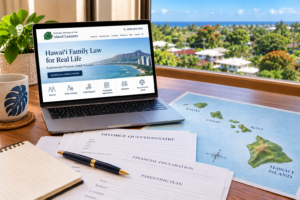
Divorce cases often require significant paperwork.
Clients may need to provide:
- Tax returns;
- Paystubs;
- Bank statements;
- Retirement account statements;
- Mortgage documents;
- Credit card statements;
- Business records;
- Real estate information;
- Childcare and medical expense records.
Many of these records contain sensitive personal and financial information, such as account numbers, Social Security numbers, and income details. For that reason, in certain instances we use secure document portals rather than ordinary email to exchange sensitive documents with our clients.
Clients can upload bank statements, retirement account statements, tax returns, and other confidential records directly to our office, and we can share drafts and case documents back the same way. This allows the attorney and client to review financial issues efficiently and securely, without requiring the client to mail or physically deliver documents to an office.
Good organization is still important. Remote representation works best when clients are able to gather records, respond to questions, and communicate promptly.
Remote Representation in Custody Cases
Child custody cases can also involve substantial remote preparation.
Video or phone meetings may be used to discuss:
- The existing parenting schedule;
- School and activity routines;
- Communication between the parents;
- Concerns about safety or stability;
- Proposed parenting plans;
- Inter-island travel issues;
- Witnesses and evidence;
- Preparation for court testimony.
For Big Island families, custody cases may also involve special logistical concerns, such as parents living on different islands, travel between the Big Island and Oʻahu, or parenting schedules that must account for flights, school breaks, and airport transportation.
Inter-Island Parenting and Travel Issues
Remote representation can be especially useful in cases involving parents who live on different islands.
For example, one parent may live in Hilo while the other lives in Honolulu. Or one parent may be considering a move from the Big Island to Oʻahu after divorce.
In those cases, a parenting plan may need to address:
- Airfare;
- Airport transportation;
- School breaks;
- Summer visitation;
- Holiday schedules;
- Missed or canceled flights;
- Virtual communication;
- The child’s comfort with travel.
These issues can often be discussed and planned remotely, but they should be addressed carefully and specifically in any custody agreement or court order.
Property and Financial Issues on the Big Island
Big Island divorce cases may involve property and financial issues that require careful analysis.
These may include:
- Family land;
- Inherited property;
- Agricultural property;
- Owner-built homes;
- Rental properties;
- Small businesses;
- Informal family financial arrangements;
- Self-employment or irregular income.
Many of these issues can be reviewed remotely through documents, photographs, financial records, appraisals, and discussions with the client. However, the legal analysis may still be complex, especially where family property, inherited assets, or closely held businesses are involved.
What Makes Remote Representation Work Well?
Remote representation works best when the attorney and client have clear expectations.
Helpful practices include:
- Scheduling regular calls or video meetings;
- Using a secure document portal to exchange financial records and other sensitive documents;
- Signing documents electronically as soon as they are ready;
- Preparing questions before meetings;
- Responding promptly to requests for information;
- Keeping financial records organized;
- Confirming deadlines in writing;
- Making sure the client understands upcoming court dates and responsibilities.
The goal is not simply to avoid travel. The goal is to make the legal process organized, efficient, and manageable.
Is Remote Representation Right for Every Divorce?
Not always.
Some cases may require more in-person work, particularly if they involve:
- Highly contested custody disputes;
- Complex trials;
- Extensive exhibits;
- Difficult credibility issues;
- Emergency hearings;
- Domestic abuse or protective order concerns;
- Clients who prefer face-to-face meetings.
Even in those cases, remote communication may still be useful for many parts of preparation. The best approach depends on the client, the case, and the issues involved.
Frequently Asked Questions About Handling a Big Island Divorce Remotely
Can I hire a Honolulu divorce lawyer for a Big Island divorce?
Yes. A Honolulu-based divorce lawyer may be able to represent clients in Big Island divorce and family law cases, particularly where the attorney practices statewide and has systems for remote communication and case preparation.
Can my divorce consultation be done by phone or video?
In many cases, yes. Initial consultations and follow-up meetings can often be handled by phone or video conference.
Will I have to travel to Honolulu for my divorce case?
Not necessarily. Many aspects of representation can be handled remotely. Whether travel is needed depends on the specific circumstances of the case.
Will I need to appear in person at Family Court in Hilo or Kona?
Often not. Big Island judges routinely allow parties and attorneys to appear by Zoom for first appearances on divorce and parentage motions, and for status hearings. Trials, evidentiary hearings, and some contested matters are more likely to require in-person attendance. Many uncontested divorces can be completed without a court appearance at all.
Can mediation be done by Zoom?
Yes. Private mediators and the non-profit mediation centers, including Kuʻikahi Mediation Center in Hilo, West Hawaiʻi Mediation Center in Kamuela, and the Mediation Center of the Pacific in Honolulu, all allow parties and attorneys to participate by Zoom.
Can custody and parenting issues be handled remotely?
Many custody-related discussions and preparation meetings can be handled remotely. However, contested custody hearings or trials may require more detailed preparation and possibly in-person participation.
Can financial documents be reviewed remotely?
Yes. Tax returns, paystubs, bank statements, retirement statements, mortgage records, and other financial documents can be uploaded through our secure document portal and reviewed electronically.
Do I need to mail or deliver original signed documents?
Generally, no. Virtually all of our documents, including representation agreements and court documents, are signed electronically through DocuSign. That means there is usually no need to mail or hand-deliver originals, and signed documents can often be filed within minutes.
Is remote representation less effective than in-person representation?
Not necessarily. Remote representation can be effective when communication is clear, documents are organized, and the attorney and client are prepared. The key is having a practical system for managing the case.
More on Big Island and Inter-Island Divorce
- How Divorce Works in Hilo Family Court
- Can a Parent Move from the Big Island to Oʻahu After Divorce?
- What Does an Inter-Island Parenting Schedule Actually Look Like?
- Can You Lose Family Land in a Hawaii Divorce?
Speak With a Hawaiʻi Divorce Lawyer Serving Big Island Clients
If you are considering divorce on the Big Island, you do not have to limit your search to attorneys with an office nearby.
Doi/Luke, Attorneys at Law assists clients throughout Honolulu, Hilo, Puna, Keaʻau, Mountain View, Kona, Waimea, and across Hawaiʻi with divorce, child custody, child support, property division, and post-divorce matters.
Our firm understands the practical realities of Big Island divorce cases and works with clients to provide clear, organized, and accessible representation. Contact us to schedule a consultation by phone or video.
This article is provided for general informational purposes only and should not be construed as legal advice. Every family law case depends on its particular facts and circumstances. If you need legal advice about your situation, consult a qualified attorney. Reading this article or contacting our firm does not create an attorney-client relationship.