
 One of the most common questions in child custody cases is:
At what age can a child decide which parent to live with?
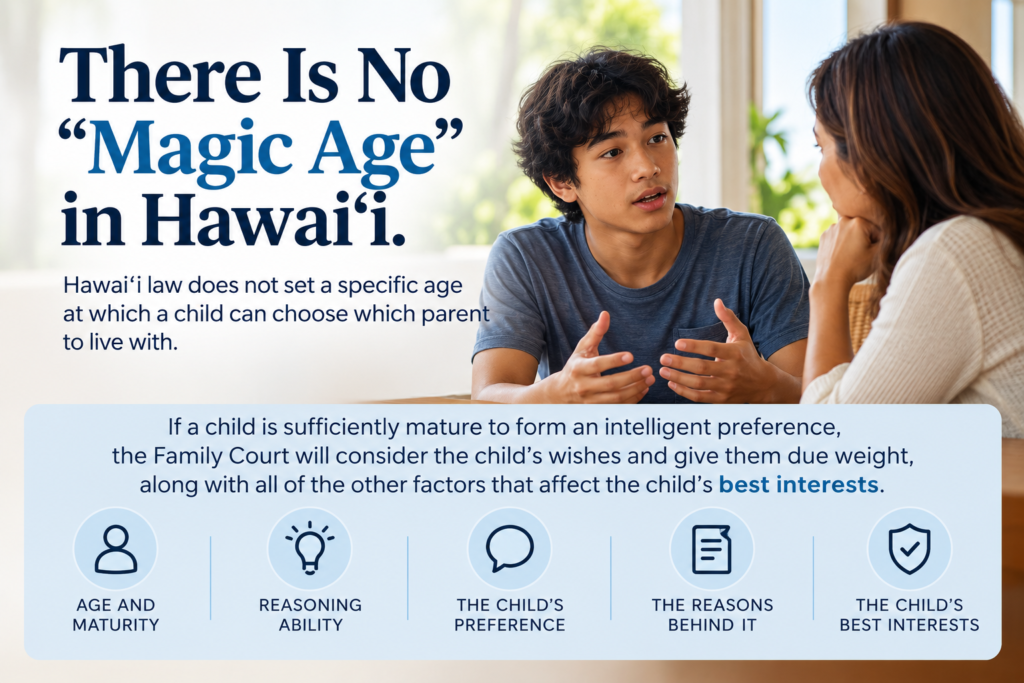
In Hawaiʻi, there is no specific age—such as 12, 14, or 16—at which a child automatically gets to choose which parent will have custody.
Instead, Hawaiʻi law provides that when a child is sufficiently mature to form an intelligent preference, the Family Court must consider the child’s wishes and give those wishes due weight.
But the child’s preference does not by itself determine custody.
The ultimate question remains: What custody arrangement is in the best interests of the child?
There Is No “Magic Age” in Hawaiʻi
Parents sometimes hear that once a child turns 12 or 14, the child can decide where to live.
That is not the law in Hawaiʻi.
Hawaiʻi Revised Statutes § 571-46(a)(3) provides:
If a child is of sufficient age and capacity to reason, so as to form an intelligent preference, the child’s wishes as to custody shall be considered and be given due weight by the court.
Notice that the statute does not identify a particular age.
Instead, the focus is on the individual child:
- Is the child mature enough to understand the situation?
- Can the child reason about the alternatives?
- Has the child formed a genuine and thoughtful preference?
- What are the reasons behind that preference?
A mature 15-year-old’s views will often carry considerably more weight than those of a much younger child. But even an older teenager does not automatically have the legal authority to decide custody.
Does the Judge Have to Follow the Child’s Preference?
No.
There is an important difference between considering a child’s wishes and allowing the child to make the custody decision. The Family Court is responsible for determining what arrangement is in the child’s best interests. A child’s preference is one part of that analysis.
For example, a teenager might strongly prefer living with one parent because:
- that parent lives closer to the child’s school and friends;
- the child has a stronger relationship with that parent;
- the child’s activities and schedule fit better in that household;
- there is less conflict in that home; or
- the child feels more comfortable or secure there.
Those reasons may be important. On the other hand, a child might prefer one household because that parent has fewer rules, allows later curfews, imposes less homework supervision, or provides greater access to electronics or a car.
The court can consider not only what the child wants, but also why the child wants it.
Does a Child’s Preference Matter More as the Child Gets Older?
Often, yes—but there is no automatic formula.
Age and maturity matter because Hawaiʻi law focuses on whether the child has the capacity to reason and form an intelligent preference. As a practical matter, the wishes of a mature teenager may carry significant weight because a parenting arrangement that an older child strongly opposes can be very difficult to make work.
But age alone is not the test.
Two children of the same age may differ greatly in maturity, independence, emotional development, and understanding of their family circumstances. The court therefore looks at the particular child rather than simply consulting an age chart.
What Else Does the Family Court Consider?
A child’s preference is only one part of Hawaiʻi’s broader best interests of the child analysis.
HRS § 571-46(b) lists numerous factors the Family Court must consider, including:
- the overall quality of the child’s relationship with each parent;
- the history of caregiving by each parent;
- the child’s physical health needs;
- the child’s emotional needs;
- the child’s safety;
- the child’s educational needs;
- the child’s relationships with siblings;
- each parent’s ability to cooperate in meeting the child’s needs;
- each parent’s ability to separate the child’s needs from the parent’s own needs;
- any history of abuse or neglect;
- evidence of drug or alcohol abuse;
- parental mental health; and
- the nature and level of conflict within the family.
The child’s preference is considered within this larger picture.
For example, a child’s desire to remain near school, friends, activities, and siblings may fit closely with several best-interest considerations. A preference that appears to result primarily from parental pressure may be viewed very differently.
Why Does the Child Want to Live With One Parent?
The reasons behind the child’s preference can be particularly important.
Suppose a 16-year-old wants to live primarily with Father because Father’s home is close to school, the child participates in several after-school activities nearby, and spending school nights there would substantially reduce the child’s daily commute.
That preference may reflect practical considerations affecting the child’s education and routine.
Compare that with a teenager who wants to live with Father because Father allows unlimited gaming, does not enforce a curfew, and rarely makes sure the child gets to school.
The preference may be equally sincere—but the Family Court is unlikely to conclude that following it would be in the child’s best interests.
In other words, the court looks beyond the answer to “Which parent do you want to live with?”
An equally important question may be “Why?”
What If the Child’s Preference Is Influenced by a Parent?
This can become an important issue in contested custody cases.
Children can be placed in an extremely difficult position when parents are involved in a high-conflict divorce or custody dispute. A child may feel pressure to choose a side, protect one parent, or tell each parent what the child believes that parent wants to hear.
In more serious situations, one parent may actively encourage the child to reject the other parent or involve the child excessively in adult disputes.
The Family Court can consider the circumstances surrounding the child’s stated preference.
A child’s expressed wishes may therefore be more persuasive when they appear to be independently formed, consistent, and based on thoughtful reasons relating to the child’s own life.
Should Parents Ask Their Children Which Parent They Want to Live With?
Generally, parents should be very careful about doing so. There is a significant difference between listening to a child’s legitimate concerns and making the child feel responsible for deciding the custody dispute.
Questions such as:
“Wouldn’t you rather live with me?”
or
“Tell the judge you want to stay here.”
can place a child directly in the middle of the parents’ conflict.
Even when a child’s views are relevant, it is usually better for the adults—and ultimately the court—to remain responsible for the custody decision. Parents can listen to a child’s concerns without making the child responsible for choosing between them.
How Does the Court Learn What the Child Wants?
There is no single procedure used in every Hawaiʻi custody case.
How a child’s views are presented may depend on the child’s age, the level of conflict between the parents, the issues being litigated, and how the particular case is being handled.
In some cases, the child’s wishes may become known through a custody investigation, custody evaluation, guardian ad litem, or other evidence presented in the custody proceeding. In other circumstances, testimony concerning the child’s views may become relevant.
Hawaiʻi law also permits the Family Court, when appropriate, to order an investigation concerning the care, welfare, and custody of a child and to appoint a guardian ad litem to represent the child’s interests.
The appropriate way to present a child’s views should be considered carefully. Having a child unnecessarily drawn into courtroom litigation between the child’s parents can create its own problems.
Can a Teenager Testify in a Custody Case?
Technically, yes. In practice, it almost never happens.
Nothing in Hawaiʻi law flatly prohibits a child from testifying in a custody case. But it is extremely rare for a Family Court judge to allow it—even when the child is a mature teenager. Even experienced family law attorneys may go many years without seeing it happen.
Judges are understandably reluctant to put a child on the witness stand in the middle of the parents’ dispute. Testifying in court, being cross-examined by a parent’s attorney, and being asked to choose between parents in front of both of them can be stressful and harmful for a child, and can damage the child’s relationship with one or both parents long after the case is over.
Instead, the court usually learns about a child’s views through other means, such as a custody investigation, a custody evaluation, or a guardian ad litem.
Parents should not build their case around having their teenager “tell the judge” where the teen wants to live. A parent who pushes to put a child on the stand may also raise questions about whether that parent is putting the child’s needs first.
What If a Teenager Refuses to Visit the Other Parent?
This is a more complicated problem than simply asking which parent the teenager prefers.
An existing custody or visitation order does not automatically cease to apply because a child says that he or she no longer wants to follow it. At the same time, enforcing a parenting schedule involving a resistant 16- or 17-year-old may present very different practical issues than enforcing one involving a six-year-old.
The reasons for the child’s refusal can be critical.
For example:
- Is the child simply angry after an argument?
- Is the child trying to avoid reasonable household rules?
- Is the child being encouraged by the other parent to refuse visitation?
- Has the relationship with the parent deteriorated?
- Does the child have legitimate concerns about what occurs in that parent’s home?
- Are there issues involving abuse, substance use, domestic violence, or safety?
A parent should not automatically treat a child’s refusal as permission to disregard an existing court order.
If the existing custody arrangement is no longer workable or appropriate, it may be necessary to ask the Family Court to modify the order.
Can a Child’s Preference Be Grounds to Modify an Existing Custody Order?
It can be relevant.
Children grow, mature, change schools, develop activities, and become increasingly independent. A custody arrangement established years earlier may no longer fit the child’s circumstances.
Hawaiʻi law allows custody orders to be modified whenever the child’s best interests require or justify modification.
A mature child’s preference may therefore be an important consideration when a parent seeks to change an existing custody arrangement.
But again, the child’s preference is not viewed in isolation.
The court will consider why the child wants the change and how the proposed arrangement would affect the child’s overall welfare.
What About an Inter-Island Custody Arrangement?
In families where the parents live on different islands, a child’s wishes may become particularly important as the child gets older.
For a young child, parents may be able to establish an inter-island parenting schedule involving relatively frequent travel between Oʻahu and Hawaiʻi Island, Maui, or Kauaʻi.
As that child becomes a teenager, things may become more complicated.
Sports, extracurricular activities, weekend jobs, school projects, friendships, and other commitments may make frequent air travel increasingly disruptive.
A teenager might therefore prefer spending most school weekends on one island while having longer periods with the other parent during school breaks and summer.
The child’s preference would not automatically control the decision, but the practical realities of the child’s life can be relevant to determining an appropriate parenting schedule.
Does a 16- or 17-Year-Old Basically Decide Anyway?
This is where the legal rule and practical reality can pull in different directions.
Legally, even a 17-year-old does not simply replace the Family Court as the decision-maker.
In practice, however, the views of an older, mature teenager can be difficult to ignore.
A custody arrangement has to function in the real world. School, activities, transportation, employment, social development, and the increasing independence of an older teenager may all affect whether an existing parenting plan remains workable.
That is still different from saying:
“Once a child turns 14, the child decides.”
Hawaiʻi law contains no such rule.
Frequently Asked Questions
At what age can a child choose which parent to live with in Hawaiʻi?
There is no specific age. If a child is sufficiently mature to reason and form an intelligent preference, Hawaiʻi law requires the court to consider the child’s wishes and give them due weight.
Can a 12-year-old choose which parent to live with?
Not automatically. The court can consider the child’s maturity, reasoning ability, preference, and reasons for that preference, together with all of the other circumstances affecting the child’s best interests.
Can a 16-year-old choose?
A mature 16-year-old’s wishes may be important, but the teenager does not have an absolute legal right to decide custody. The Family Court remains responsible for determining the child’s best interests.
Does the judge have to do what the child wants?
No. The child’s preference is a factor—not the final decision.
Can a child refuse visitation with the other parent?
A child’s refusal does not automatically cancel an existing custody or visitation order. The child’s age, reasons for refusing, safety concerns, parental conduct, and the practical ability to continue the existing arrangement may all be relevant. If the existing order no longer serves the child’s best interests, a parent may need to seek a custody modification.
Can the child’s preference justify changing custody?
Potentially. Hawaiʻi custody orders may be modified when the child’s best interests require or justify a change. A mature child’s well-reasoned preference may be one important consideration in determining whether modification is appropriate.
More About Child Custody in Hawaiʻi
- Understanding Child Custody in Hawai’i: Legal vs. Physical Custody
- Can a Parent Move from the Big Island to O’ahu After Divorce?
- Child Custody and Visitation in Hawai’i
The Bottom Line
Children in Hawaiʻi do not reach a particular age at which they automatically get to choose which parent they live with.
Instead, Hawaiʻi law takes a more individualized approach.
If a child has sufficient maturity and ability to reason and has formed an intelligent preference, the Family Court must consider the child’s wishes and give those wishes due weight.
But the child does not have to make the decision—and should not be placed in the position of feeling responsible for choosing between parents.
The Family Court’s job is still to determine the custody arrangement that serves the best interests of the child.
When Your Child’s Wishes Become Part of a Custody Dispute
If your child is asking to live primarily with one parent, refusing parenting time, or expressing strong preferences about the current custody arrangement, the situation can become difficult for everyone involved.
The attorneys at Doi/Luke, Attorneys at Law handle child custody and custody-modification cases throughout Hawaiʻi. We can help you understand how your child’s age, maturity, stated preferences, and the other circumstances of your case may be considered by the Family Court.
Contact us to schedule a consultation about your Hawaiʻi child custody matter.
Disclaimer
This article provides general information about Hawaiʻi law and is intended for educational purposes only. It should not be considered legal advice or relied upon as a substitute for advice from an attorney regarding your particular circumstances. Laws, court procedures, and legal standards may change, and the application of the law depends on the specific facts of each case. Reading this article or contacting Doi/Luke, Attorneys at Law through this website does not, by itself, create an attorney-client relationship. If you need legal advice regarding your individual situation, you should consult with a qualified attorney.