
When parents live on different Hawaiian islands, keeping both relationships strong takes more planning than a typical custody arrangement. Inter-island parenting schedules also frequently become an issue when one parent relocates from the Big Island to Oʻahu after divorce or after parents separate in a parentage/paternity case.
The good news: many Hawaiʻi families build parenting plans that let children stay closely connected to both parents without constant, exhausting travel.
If you’re facing an inter-island custody situation, here’s a look at the options families actually use—and what to consider before settling on one.
There Is No “Standard” Inter-Island Parenting Schedule
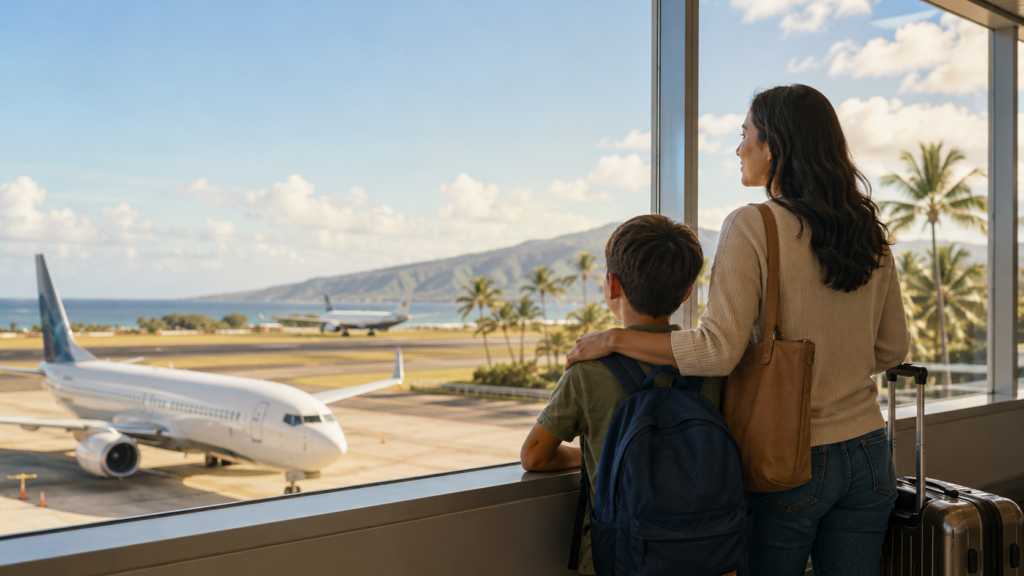
Parents who live in the same community can rely on familiar, predictable patterns. Parents living on different islands have to plan around air travel, school calendars, transportation, and the added cost of getting a child from one island to another.
That means there’s no one-size-fits-all schedule.
Instead, Hawaiʻi Family Courts focus on building arrangements that serve the child’s best interests while keeping both parents actively involved in the child’s life.
Common Parenting Schedule Options
Every family is different, but a handful of arrangements come up again and again for parents living on separate islands.
Extended School Breaks
Rather than frequent weekend visits, many families divide the longer school breaks instead. For example:
- Most of summer vacation with one parent.
- Alternating spring break or fall break.
- Alternating Thanksgiving.
- Sharing winter break.
This cuts down on the number of flights while still giving the child meaningful, uninterrupted time with each parent.
Long Holiday Weekends
When it’s practical, families may also build in parenting time around:
- Presidents’ Day weekend.
- Memorial Day weekend.
- Labor Day weekend.
- Other three-day school holidays.
Depending on flight schedules and the child’s age, these shorter visits can supplement the longer school breaks.
Monthly Weekend Visits
Some families choose one weekend a month, particularly when direct flights are available and the child is a bit older.
This tends to work well when:
- travel time is relatively short;
- school attendance isn’t disrupted; and
- the child is comfortable flying.
For younger children, though, that much travel can get tiring fast—and less practical for everyone involved.
Virtual Parenting Time Matters, Too
Technology makes it easier than ever for kids to stay in regular contact with the parent who lives on another island.
Many parenting plans schedule:
- FaceTime or video calls;
- phone calls;
- text messaging (when age-appropriate);
- online homework help;
- virtual participation in birthdays or other special occasions.
Virtual communication can’t replace in-person time, but it goes a long way toward keeping that relationship strong between visits.
Transportation Is a Bigger Deal Than It Sounds
A well-written parenting plan covers more than dates on a calendar. Parents should also work out:
- Who purchases the airline tickets?
- How far in advance do flights need to be booked?
- Which parent gets the child to and from the airport?
- What happens if a flight is delayed or cancelled?
- How are unexpected travel expenses handled?
- Does the child qualify to fly as an unaccompanied minor?
Working through these questions up front heads off a lot of misunderstandings—and conflict—later.
Don’t Forget School and Activities
Kids’ schedules get busier as they get older. Sports, music lessons, other extracurriculars, and academic commitments can all start competing with travel plans.
A schedule that worked well for a six-year-old may need real adjustments once that child hits the teenage years.
The most successful parenting plans build in enough flexibility to adapt to those changing needs, without losing sight of meaningful time with both parents.
Parents Can Get Creative
Some of the best parenting plans are the ones built around a family’s specific circumstances rather than a generic template. Parents might agree to:
- alternate longer school vacations;
- split summer into several extended visits;
- add parenting time whenever the traveling parent happens to be on the child’s island anyway;
- adjust the schedule around important family events or celebrations;
- trade parenting time to work around school or job obligations.
The goal isn’t dividing every month equally—it’s making sure the child gets to keep a strong, continuing relationship with both parents.
What Happens If Parents Can’t Agree?
If parents can’t reach an agreement on their own, upon motion by one of the parents, the Family Court can step in to set a schedule it believes serves the child’s best interests.
The court typically considers:
- the child’s age and developmental needs;
- how well the parents are able to cooperate;
- travel logistics and expense;
- the child’s educational needs;
- each parent’s relationship with the child; and
- how practical the proposed schedule actually is.
Because every family’s situation is different, the outcome depends heavily on the specific facts of the case.
Planning Ahead Now Saves Conflict Later
The inter-island parenting plans that hold up best are detailed, realistic, and built with the child’s long-term needs in mind.
Taking the time up front to work through travel logistics, communication, holidays, school breaks, and how the plan will adapt as your child grows can save your family a lot of avoidable conflict—and give your child the stability they need.
Helping Hawaiʻi Families Navigate Inter-Island Parenting
We regularly help parents throughout Hawaiʻi, including families dealing with divorce and family law matters on the Big Island, work through child custody, parenting plans, and relocation issues.
Whether one parent is on Oʻahu and the other on the Big Island—or any other combination of the Hawaiian Islands—we help families build practical parenting arrangements that protect the child’s best interests while preserving strong relationships with both parents.
If you have questions about creating or modifying an inter-island parenting schedule, contact Doi/Luke, Attorneys at Law to schedule a confidential consultation. We’ll help you figure out what’s realistic for your family—and how to get it in writing.
Frequently Asked Questions
Who usually pays for airfare in an inter-island parenting schedule?
There’s no universal rule. Parents may split the cost, divide up transportation responsibilities, or work out another arrangement that fits their finances and their parenting plan.
Can a child fly alone between islands?
Depending on the child’s age and the airline’s policies, children may be eligible to travel as unaccompanied minors. Parents should factor those requirements into the parenting schedule. See the Alaska Airlines and Hawaiian Airlines guidelines and the Southwest Airlines guidelines for unaccompanied minors.
Can an inter-island parenting schedule be modified later?
Yes. As children get older or family circumstances change, parents can agree to modify the schedule themselves or ask the Family Court to consider a modification if appropriate.
Is equal parenting time required when parents live on different islands?
Not necessarily, and not typically. The court’s focus is on the child’s best interests, not on hitting a mathematically equal division of time. Schedules are often built to maximize meaningful time with each parent while working within the practical realities of inter-island travel.
More about child custody and visitation in Hawai’i:
Child Custody and Visitation in Hawai’i
Understanding Child Custody in Hawai’i — Legal vs. Physical Custody
What Does an Inter-Island Parenting Schedule Look Like?