
 When couples think about preparing a prenuptial agreement in Hawaiʻi, much of the discussion naturally focuses on the agreement itself: What property will remain separate? What happens to income earned during the marriage? Will either spouse receive alimony if the marriage ends?
But there is another important part of the prenup process that should not be overlooked: financial disclosure.
Before signing a prenuptial agreement, each person should have a reasonably clear understanding of the other person’s financial situation. That generally means identifying significant assets and debts and providing reasonable information about their values.
Good financial disclosure does more than help the parties make informed decisions. It can also make a prenuptial agreement much more difficult to challenge years later.
Why Does Financial Disclosure Matter in a Hawaiʻi Prenup?
Hawaiʻi has adopted the Uniform Premarital Agreement Act, found in Chapter 572D of the Hawaiʻi Revised Statutes.
Under HRS § 572D-6, a prenuptial agreement is generally enforceable unless the person challenging it proves either that the agreement was not entered into voluntarily, or that the agreement was unconscionable when it was signed and certain additional requirements involving financial disclosure and knowledge were also present.
Those disclosure-related factors include whether the challenging party:
- was provided a fair and reasonable disclosure of the other person’s property or financial obligations;
- voluntarily and expressly waived in writing the right to additional disclosure; and
- had, or reasonably could have had, adequate knowledge of the other person’s property and financial obligations.
In other words, Hawaiʻi law does not simply say that every asset must be disclosed down to the last dollar or the agreement automatically becomes invalid. The statutory test is more nuanced. But disclosure can become extremely important if the agreement is later challenged.
The Hawaiʻi Supreme Court has also explained that one aspect of unconscionability is “unfair surprise”—including whether a person had adequate knowledge of the other prospective spouse’s financial condition when the agreement was made. See Lewis v. Le
wis, 69 Haw. 497, 748 P.2d 1362 (1988).
For that reason, our usual approach is simple: when in doubt, disclose it.
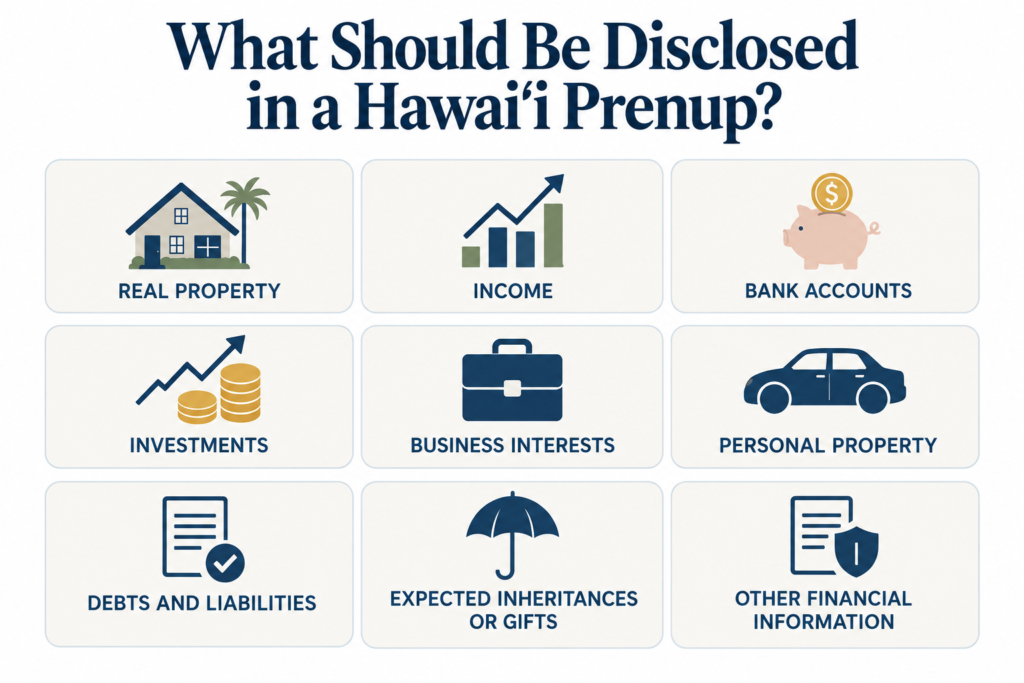
What Should Be Disclosed Before Signing a Prenup?
The appropriate level of disclosure depends somewhat on the couple’s circumstances, but financial disclosure commonly includes the following.
Real Estate
Each person should ordinarily identify real property that they own, including:
- homes and condominiums;
- rental properties;
- vacant land;
- interests in family property; and
- property owned jointly with relatives or other people.
This applies to property in or outside of Hawaiʻi. The disclosure should generally include a reasonable estimate of a property’s value and any mortgage or other debt secured by the property.
A formal appraisal is not necessarily required for every property—a reasonable, good-faith estimate is usually sufficient, though valuable or unusual properties may call for more precise valuation information.
Bank and Investment Accounts
Financial disclosure should generally identify accounts, including:
- checking and savings accounts;
- certificates of deposit;
- brokerage accounts;
- stocks, bonds, mutual funds, or other securities;
- cryptocurrency or other digital assets; and
- other significant investments.
Exact balances can change from day to day. The objective is generally to give the other person a general picture of the asset, rather than pretending that an account balance will remain frozen on the date the disclosure is prepared.
Retirement Accounts
Retirement assets can represent a substantial portion of a person’s net worth.
Disclosure may include:
- 401(k) accounts;
- 403(b) accounts;
- IRAs;
- pensions;
- military retirement benefits;
- government retirement plans; and
- other deferred compensation or retirement benefits.
This can be particularly important because a prenup may address not only the retirement benefits a person already has before marriage, but also how additional retirement benefits earned during the marriage will be treated.
Businesses and Professional Practices
Business interests often require more careful disclosure.
A person who owns a company, partnership interest, professional practice, LLC, or other closely held business should generally identify the ownership interest and provide enough information to give the other prospective spouse a reasonable understanding of its nature and approximate value.
That does not necessarily mean that every business needs an expensive formal valuation before the wedding.
Depending on the circumstances, disclosure could include information such as:
- the percentage of the business owned;
- an estimated value;
- recent financial statements;
- tax returns;
- ownership agreements; or
- other information relevant to the business.
The appropriate amount of information depends heavily on the size and complexity of the business.
Debts and Financial Obligations
Disclosure should not focus only on assets.
HRS § 572D-6 specifically refers to disclosure of both property and financial obligations.
That means significant debts should also be identified, including:
- mortgages;
- home equity loans;
- credit card debt;
- student loans;
- personal loans;
- tax liabilities;
- business guarantees; and
- other substantial financial obligations.
Someone deciding whether to sign a prenup should know not only that the other person owns a $1 million property, for example, but also that the property carries an $850,000 mortgage.
Should Income Also Be Disclosed?
Almost always, yes.
Although the statutory language specifically refers to property and financial obligations, income can be highly relevant to the terms being negotiated—particularly if the agreement addresses alimony, the treatment of earnings during the marriage, contributions toward household expenses, or accumulation of marital property.
Typical income information might include:
- salary or wages;
- bonuses and commissions;
- self-employment income;
- business distributions;
- rental income;
- retirement income; and
- other substantial recurring income.
Recent tax returns, W-2s, 1099s, or pay statements may provide an efficient way to document this information.
How Precise Do the Numbers Have to Be?
One common concern is whether every asset must be professionally valued before a prenup can be signed.
Usually, that is unnecessary.
The statutory phrase is “fair and reasonable disclosure,” not perfect financial accounting.
For example, if someone owns a home that is reasonably believed to be worth approximately $900,000, the disclosure might state an estimated value of $900,000 and identify the approximate mortgage balance. It will generally not be necessary to obtain a new appraisal merely because Zillow, the county tax assessment, and the owner’s estimate differ somewhat.
Similarly, an investment account can normally be disclosed using a recent approximate balance rather than requiring the parties to update the agreement every time the stock market moves.
What matters is that the disclosure fairly communicates the person’s financial circumstances.
Intentional concealment of a substantial asset is an entirely different issue.
Does Every Financial Document Have to Be Attached to the Prenup?
Not necessarily.
A common approach is to attach a financial schedule or exhibit to the prenuptial agreement listing each person’s major assets and liabilities.
For example:
Assets
- Residence — estimated value $950,000; mortgage approximately $480,000
- Fidelity investment account — approximately $275,000
- 401(k) — approximately $310,000
- 50% interest in ABC LLC — estimated value $200,000
- Checking and savings — approximately $65,000
Liabilities
- Mortgage — approximately $480,000
- Student loan — approximately $35,000
- Credit card balance — approximately $8,000
Underlying documents can also be exchanged between the parties and their attorneys without necessarily attaching every bank statement, tax return, or retirement statement to the final agreement.
For couples with more complicated finances, keeping a clear record of what documents were provided can be helpful if questions arise years later.
Can Someone Waive Additional Financial Disclosure?
Yes.
HRS § 572D-6 expressly recognizes that a person may voluntarily and expressly waive in writing the right to disclosure beyond the disclosure already provided.
That can be useful when both prospective spouses already understand each other’s finances and do not believe additional documentation is necessary.
But a waiver of additional disclosure should not be viewed as an excuse to hide assets.
There is a significant difference between saying:
“I have received sufficient information about my fiancé’s finances and do not need additional statements or documentation.”
and:
“I don’t know what my fiancé owns and don’t want to know.”
The first may be perfectly reasonable. The second creates unnecessary risk.
What If the Couple Already Knows Each Other’s Finances?
That matters too.
The Hawaiʻi statute recognizes whether the person challenging the agreement had, or reasonably could have had, adequate knowledge of the other person’s financial circumstances.
Hawaiʻi appellate decisions have considered the parties’ actual knowledge when evaluating challenges to premarital agreements.
For example, in Prell v. Silverstein, the Intermediate Court of Appeals addressed a premarital agreement where both parties essentially entered the marriage without assets. The court concluded that the wife had adequate disclosure of the husband’s financial condition because there was effectively nothing substantial to disclose at the time. 114 Hawaiʻi 286, 162 P.3d 2 (App. 2007).
More recently, the Hawaiʻi Supreme Court reiterated that the statutory analysis includes whether the challenging spouse had adequate knowledge of the other spouse’s property and obligations. L.R.O. v. N.D.O., 148 Hawaiʻi 336, 475 P.3d 1167 (2020).
Nevertheless, relying solely on the argument that “she already knew what I owned” is much less desirable than documenting the disclosure before the agreement is signed.
Memories change. Relationships change. And a court reviewing the agreement 10 or 20 years later will have to determine what actually happened before the marriage.
Written disclosure creates a record.
What About Future Inheritances?
A future inheritance is different from an asset that a person presently owns.
A person generally cannot know with certainty whether a parent or other relative will leave property to them years in the future. Estate plans can change, property can be spent, and circumstances can change dramatically.
Indeed, Prell involved an argument concerning wealth one spouse later received from family members. The court noted that there was no evidence that, when the premarital agreement was signed, either spouse knew or reasonably expected that the later gifts or inheritances would occur.
A current ownership interest or existing beneficial interest in a trust, however, may present a different situation and should be discussed with the attorney preparing the agreement.
Prenuptial agreements can also specifically address how future gifts and inheritances will be treated even though the amount of those future assets cannot presently be known.
What Happens If Someone Leaves an Asset Off the Disclosure?
It depends.
An accidentally omitted small bank account is very different from deliberately failing to disclose a multimillion-dollar business.
A disclosure problem also does not necessarily mean that the entire prenuptial agreement automatically becomes unenforceable. Hawaiʻi’s statutory test requires a broader analysis.
The Hawaiʻi Supreme Court has described unconscionability under HRS § 572D-6 as requiring both a substantive component—an unjustly disproportionate result—and a procedural component, such as unfair surprise or inadequate financial knowledge. L.R.O. v. N.D.O., 148 Hawaiʻi 336, 475 P.3d 1167 (2020).
Still, there is little reason to create that problem in the first place.
Thorough disclosure at the beginning is generally easier and far less expensive than litigating the adequacy of disclosure during a divorce many years later.
Financial Disclosure Is Not Just for Wealthy Couples
Couples sometimes assume formal financial disclosure is necessary only when one person is extremely wealthy.
That is not the case.
Consider a couple where:
- one person owns a condominium with substantial equity;
- the other has a pension and $150,000 in retirement savings;
- one has $80,000 in student loans; and
- both expect their earnings to increase considerably during the marriage.
They may not think of themselves as wealthy. Nevertheless, their financial circumstances could change dramatically during a 20- or 30-year marriage.
A straightforward financial disclosure provides both parties with a clear starting point.
A Good Prenup Process Creates a Record
A well-prepared prenuptial agreement is not simply a document produced for two people to sign shortly before their wedding.
It is a process.
Ideally, that process leaves a clear record showing that:
- the parties began the prenup process sufficiently before the wedding;
- each person understood the important terms of the agreement;
- each person had an opportunity to consult independent counsel;
- each person knew the other’s general financial circumstances;
- assets and liabilities were disclosed in writing;
- questions about the disclosure could be asked and answered; and
- both parties voluntarily signed the final agreement.
No drafting process can guarantee that a prenuptial agreement will never be challenged. But careful financial disclosure eliminates one of the most predictable arguments that may otherwise arise.
Do You Need Financial Disclosure for a Hawaiʻi Prenup?
As a practical matter, yes—financial disclosure for Hawaii prenups are a necessary part of preparing a strong, enforceable prenuptial agreement.
Hawaiʻi law does not impose a mechanical rule requiring a particular financial statement, appraisal, or stack of bank records in every case. Instead, the law looks at whether there was fair and reasonable disclosure, whether additional disclosure was properly waived, and what the parties actually knew about each other’s finances.
The right amount of disclosure therefore depends on the circumstances.
For a couple with relatively simple finances, a page or two listing their assets and debts may be sufficient.
For someone with businesses, trusts, multiple properties, complex investments, substantial debt, or significant family wealth, considerably more information may be appropriate.
The goal is not to make preparing a prenup unnecessarily complicated.
The goal is to make sure that both people know what they are agreeing to—and that there is a good record showing that they did.
Talk to a Hawaiʻi Prenuptial Agreement Attorney
Doi/Luke, Attorneys at Law assists clients throughout Hawaiʻi with the preparation and review of prenuptial agreements, and one of our partners, Gavin Doi, has worked on hundreds of prenuptial agreements, drafting, reviewing, and defending them.
We can help determine what financial information should be disclosed, how assets and liabilities should be identified in the agreement, and how the prenup can be structured to reflect the couple’s particular circumstances and goals.
If you are considering a prenuptial agreement, it is generally better to begin the process well before the wedding date, particularly when either person has substantial or complicated financial interests.
Further Reading About Prenuptial Agreements in Hawai’i: